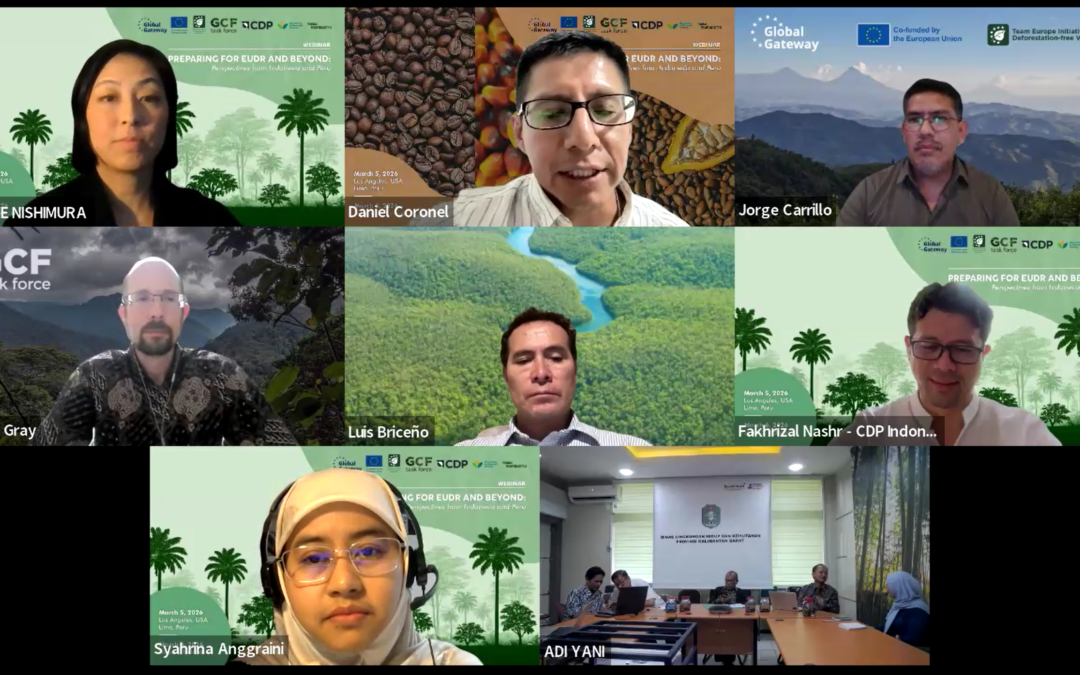
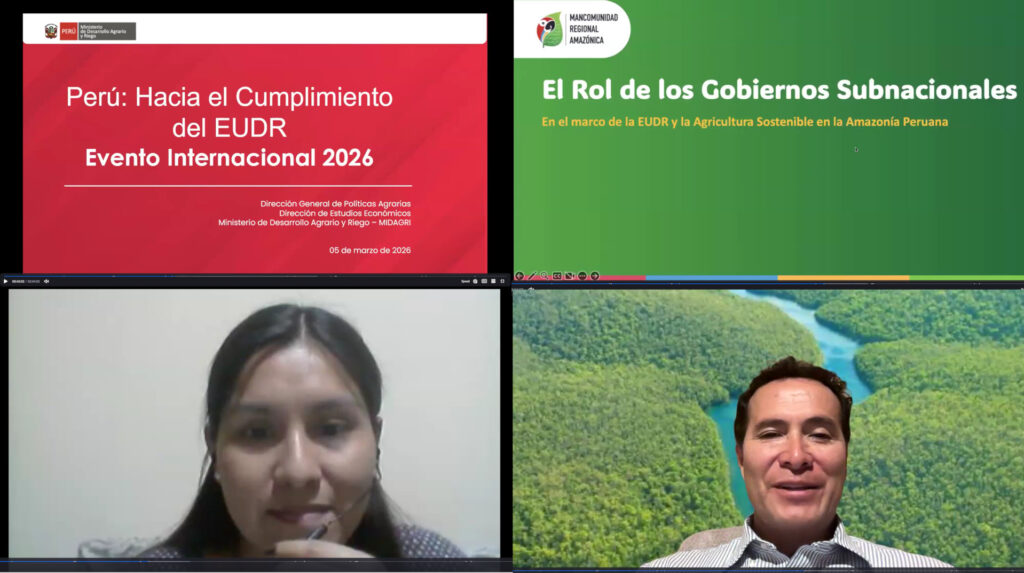
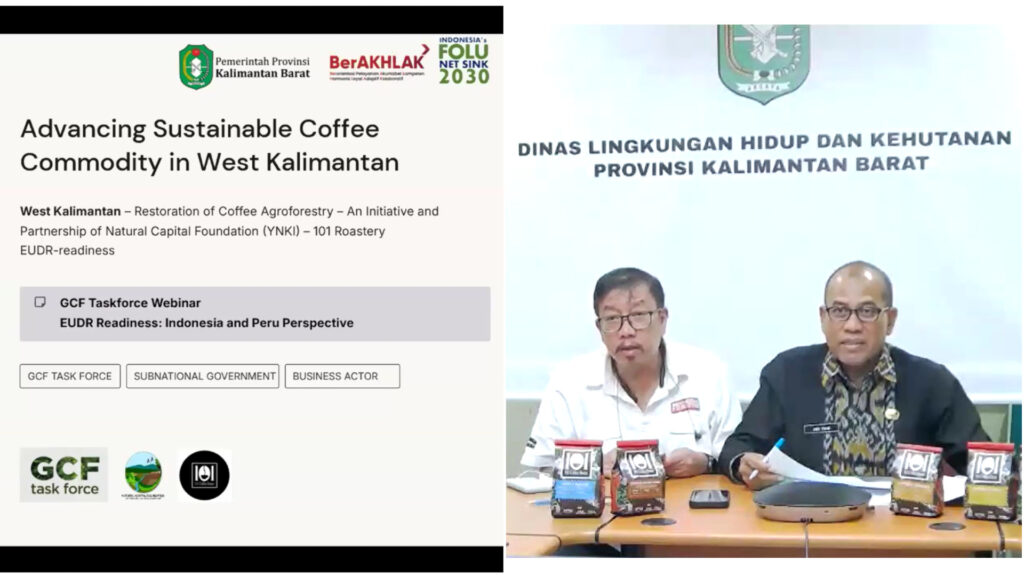
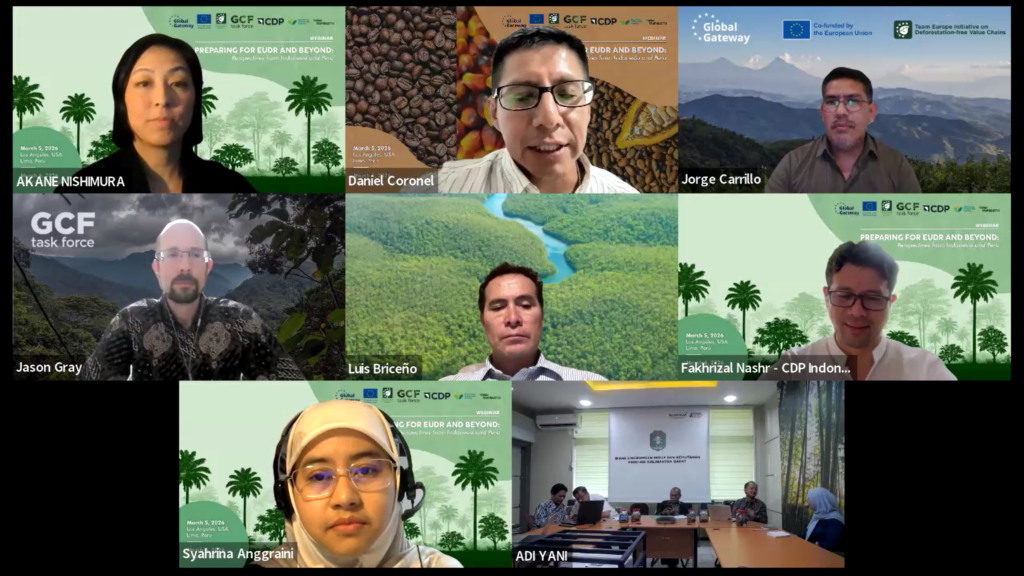
On March 5, 2026, we held our first EUDR readiness webinar, and it was a big success! Many thanks to our speakers for their time and expertise:
- Adi Yani, Head of the Department of Environment and Forestry in West Kalimantan, Indonesia
- Luis Briceño, Executive Director of MRA (Amazon Regional Association) Mancomunidad Regional Amazónica
- Lory Acosta of Peru’s MIDAGRI (Ministry of Agricultural Development and Irrigation) Ministerio de Desarrollo Agrario y Riego
- Linh Bui Thi and Jorge Carrillo from GIZ and the Team Europe Initiative (TEI) on Deforestation-Free Value Chains
- Fakhrizal Nashr from CDP
This webinar, with over 100 participants, brought together perspectives from Indonesia and Peru as tropical commodity producing countries to share strategies in addressing the EU Deforestation Regulation (EUDR). This regulation requires that commodities such as coffee, cocoa, and palm oil marketed to the European Union must not originate from land that experienced deforestation after 2020.
EUDR compliance comes with administrative and financial burdens but also presents possible strategic opportunities and secondary long-term benefits. For example, we discussed the “dual use of data” – data collected for compliance can be used not only for supply chain transparency, but also for alternative purposes like emissions reporting and attracting novel investments. We also discussed how standardized reporting systems can be used to connect producers and suppliers with global buyers and investors.
National and subnational governments and NGOs in Indonesia and Peru are working to ensure that smallholder farmers can participate with minimal cost and administrative effort. In West Kalimantan, Indonesia, the Participatory Guarantee System is a community-based assurance system that can reduce individual costs, especially over the long term. In Peru, MIDAGRI has registered over 2 million producers in its Agrarian Producers Registry (PPA) and has mapped over 150,000 polygons in its AGRODIGITAL application to conduct georeferencing and polygon mapping of farmers’ land. In addition to mapping, registration, and high implementation costs, we identified other challenges including unclear land ownership and land tenure and fragmentation between private sector and government data systems.
As farmers, producers and governments work towards EUDR compliance for 2027, the following recommendations were identified in the webinar:
- Establish multisector coordination platforms between national governments, local governments, the private sector, and farmer organizations to promote alignment and clear communication with farmers.
- Strengthen farmer organizations, such as cooperatives or producer groups, to lower administrative costs and facilitate collective compliance.
- Accelerate data interoperability between national farmer registries, local government systems, and international platforms to support deforestation data validation.
- Develop financing mechanisms that support the transition toward deforestation-free production.
Join us at our next Indonesia and Peru technical interchange webinar in April 2026 to discuss these issues and more!
Thank you to our partners:
- Global Gateway https://commission.europa.eu/topics/international-partnerships/global-gateway_en
- TEI https://zerodeforestationhub.eu/
- Deutsche Gesellschaft für Internationale Zusammenarbeit (GIZ) GmbH https://www.giz.de/en
- Dept. of Environment and Forestry, W. Kalimantan https://lhk.kalbarprov.go.id/
- CDP https://www.cdp.net/
- MIDAGRI https://www.gob.pe/midagri
- MRA https://www.facebook.com/mancomunidadregionalamazonica
- Mecanismos de Desarrollo Alternos (MDA) https://mda.org.pe/
- Yayasan Bumi Eka Lestari (BATARI) https://batari.org/