
Acre, Brazil
Brazil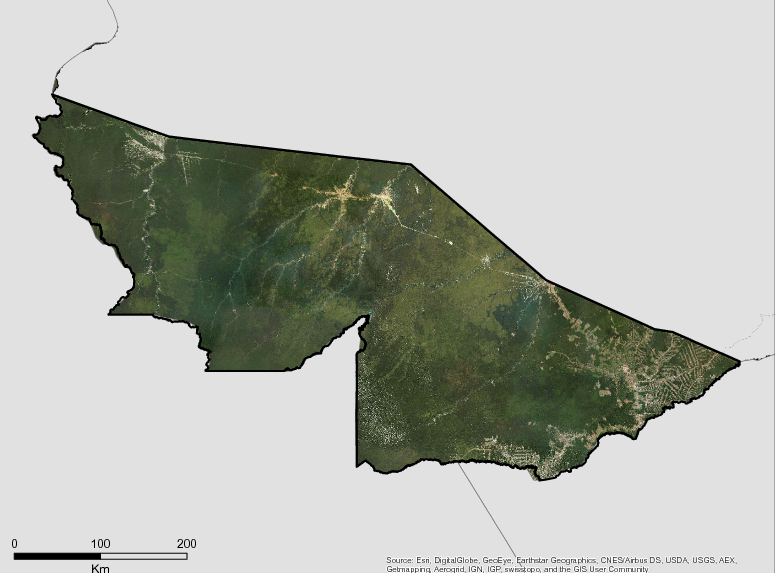
Description
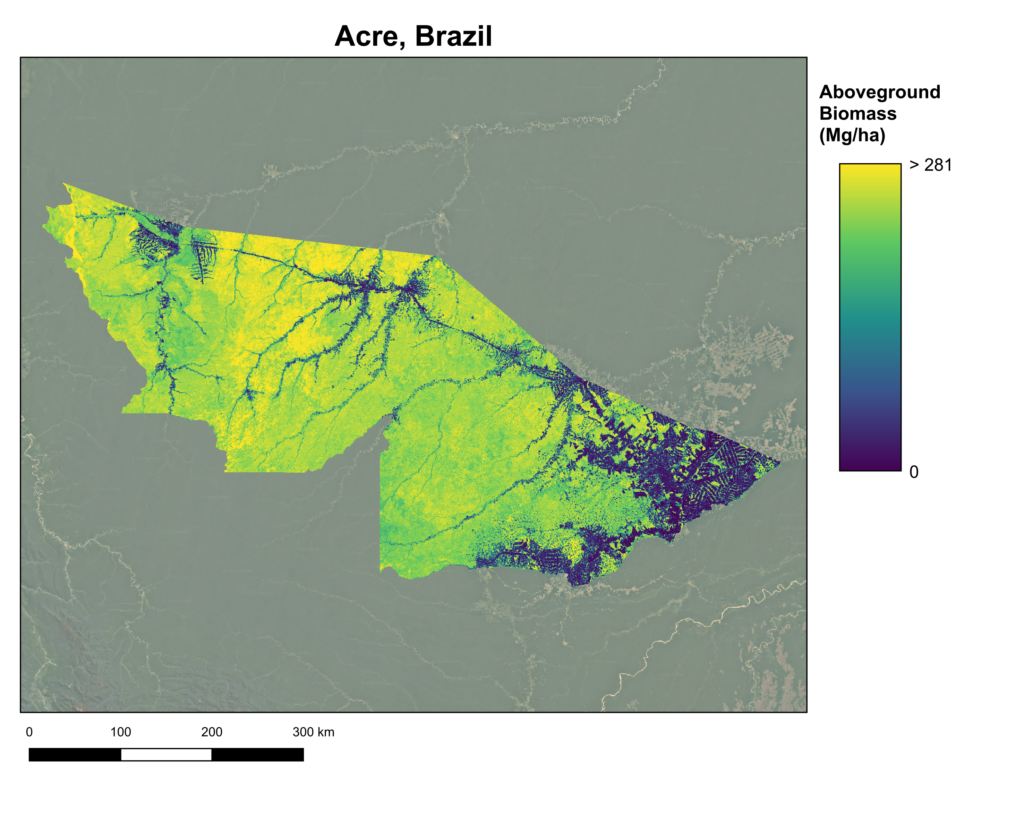
The State of Acre covers 164.123.712 km2 and is divided into 22 municipalities. In 2017 the population was estimated to be 829.619 with a population density of 5.05 inhabitants/km², and a projection for the population to grow to 972,464 by 2030. Despite its small area, Acre has immense biological wealth resulting from its geological and climatic conditions. With altitudes ranging from 250 to 580 meters, the landscape contains hills and plateaus inherited from its paleogeographical evolution, and wetlands and flood areas with typical vegetation types. The climate is characterized by two distinct periods: a “summer” with temperatures between 24,5 and 32 degrees Celsius, 1.600 to 2.750 mm of rainfall per year and high humidity, and a dry “winter” that may extend for up to 3 months. Acre has over 87% of its original forest intact, of which 47% are protected areas, 14% indigenous lands and 33% conservation units, demonstrating the conservation strategy adopted in its development policy and maintaining a rich biodiversity under canopy of different forest formations.
The state of Acre is one of the most advanced REDD jurisdictions in the world. In 2010, Acre enacted its landmark Law 2.308/2010, creating a State System of Incentives for Environmental Services (SISA), with REDD as the centerpiece. It provides an innovative, jurisdiction-wide approach to low-carbon rural development. The SISA establishes a set of principles, policies, institutions, and instruments for building an effective program for achieving environmental sustainability through ecosystem services incentives. It is designed to promote public-private initiatives to achieve the state’s goals with respect to ecosystem services. Notably, Acre established its SISA law through in-depth consultation with local stakeholders and civil society, in compliance with national level REDD+ safeguards principles and criteria.
Acre´s state government has chosen a different development model, exploring the natural resources wisely, aware of the need to preserve this valuable natural capital. Over the last fifteen years, the state government has been innovating with a green economy model, reducing deforestation, increasing its GDP and revolutionizing with socio-productive inclusion. Starting from Acre´s Ecological-Economic Zoning (ZEE), the Valuation of Forest and Environmental Assets Policy was passed into state law (Law 2.024/2008), with the main objective of ensuring the sustainable use and proper management of the territory with social and economic inclusion. This policy has contributed to the mitigation and adaptation to climate change, and the consequent reduction of greenhouse gas emissions.
Acre State Government has the implementation of its Prevention and Control of Deforestation, Burning and Forest Fires Plan (PPCDQ) as one of its main policy instruments aimed at reducing the impacts of climate change. This plan establishes guidelines, goals and actions until 2030, for territorial and land planning, productive chains and sustainable practices, and monitoring, control and surveillance. In the period 2004-2017, the state showed a 66% reduction in deforestation compared to the average for the decade 1996-2005, with average annual deforestation of 327 km² (PRODES, 2017)
Additional information can be found on the GCF Impact Platform.
Summary
Demographics
Urban vs. Rural Population
| Category | % | |
|---|---|---|
| Urban | 74.40 | |
| Rural | 25.60 |
Ethnic Groups
| Group | % | |
|---|---|---|
| Multi-ethnic | 66.30 | |
| White | 21.40 | |
| Black | 8.60 | |
| Indigenous | 3.5 |
Economy
GDP Breakdown
| Category | % | |
|---|---|---|
| Services | 74.00 | |
| Agriculture, Forestry | 18.90 | |
| Industry | 7.1 |
Forest Status
Major Vegetation Types
| Category | km² | |
|---|---|---|
| Forest | 142,007 * | |
| Pastureland | 14,030 * | |
| Secondary Vegetation | 3,710 * | |
| Other Land Uses | 3,290 * | |
| Agriculture | 68 * |
Forest Management
| Category | km² | |
|---|---|---|
| Unprotected | 95,822 * | |
| Protected | 52,678 * |
Drivers of Deforestation
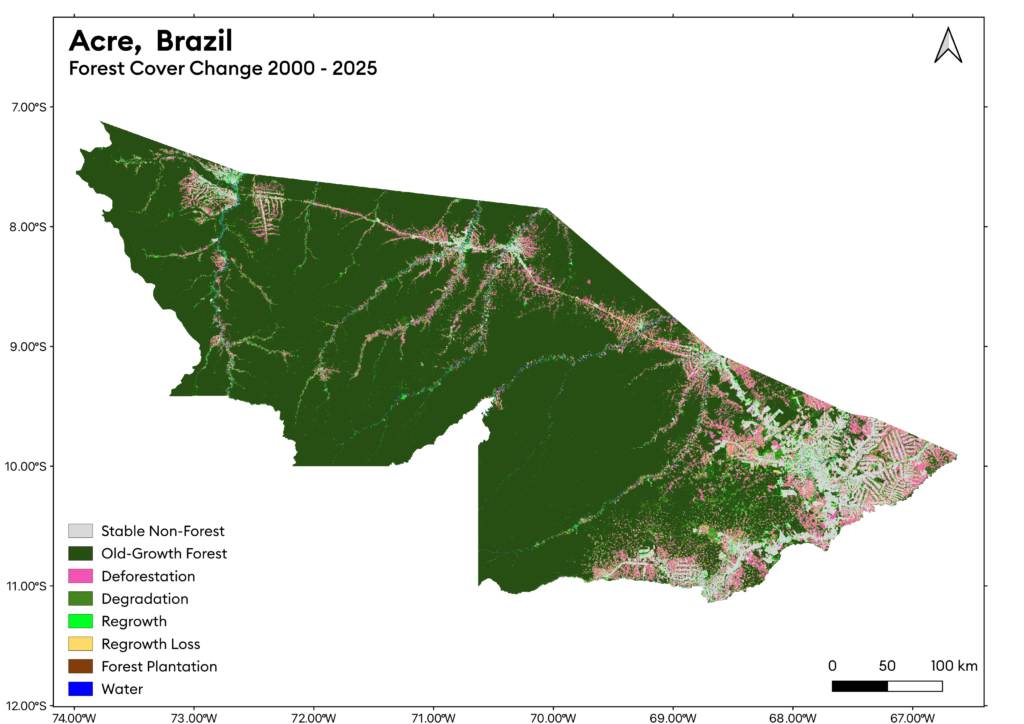
The majority of deforestation in Acre occurs along primary and secondary roads as well as rivers. The main driver of deforestation in Acre is cattle ranching (occupying 70% of the total area deforested in 1989 and increasing to 81% in 2004). Factors such as land speculation, lack of zoning and formal designation of public lands, profitability of cattle ranching, and subsidized loans for ranching have created incentives for deforestation throughout the Amazon, including Acre. Historically, the main agents of deforestation agents were owners of mid-size and large farms and ranches, but in recent years smallholder farmers have contributed significantly to deforestation in Acre. The pavement of the BR-317 (completed in 2007) and BR-364 (completed in 2011) highways now connect the southwestern Amazon (including Acre) to Peruvian Pacific coast harbors and is likely to lead to increased deforestation. The risk of deforestation is likely to be most intense along the BR-364 from Sena Madureira to Cruzeiro do Sul.
Deforestation Rates
Notes
| a. | Due to different methodological approaches and base years, Forest Status data fields may differ slightly. Data sources for each field are listed below. |
Sources
| 1. | ACRE, 2010. Zoneamento Ecológico Econômico do Estado do Acre Fase II (Escala 1:250.000). link |
| 2. | IBGE 2017 |
| 3. | IBGE. 2012. Censo Demográfico 2010. IBGE |
| 4. | IBGE.2012. Censo Demográfico 2010. IBGE |
| 5. | SEPLAN 2015 |
| 6. | IBGE 2015 |
| 7. | ACRE, 2011. Acre em Números 2011 link |
| 8. | |
| 9. | ACRE, 2010. Zoneamento Ecológico Econômico do Estado do Acre Fase II (Escala 1:250.000) link |
| 10. | PRODES 2015 |
| 11. | Prodes link |
| 12. | TerraClass 2014 |
Overview of Forest Monitoring and Measurement Systems
The Projeto de Monitoramento do Desmatameto (PRODES), led by the National Space Research Institute (INPE), conducts satellites monitoring of deforestation in the Legal Amazon and has been producing annual deforestation rates in the region since 1988, which are used by the Brazilian government for the establishment of public policies. The annual rates are estimated from the deforestation increments identified in each satellite image that covers the Legal Amazon. The data is first released in December of each year as an estimate, which is refined during the first half of the following year.
PRODES uses satellite images of the LANDSAT class (20-30 meters of spatial resolution and 16-day revisit rate) in a combination that seeks to minimize the problem of cloud coverage and ensure consistency. The LANDSAT-5 satellite images were historically the most used by the project, but CBERS-2 and CBERS-2B CCD images, satellites of the Sino-Brazilian remote sensing program, are now widely used. PRODES also made use of LISS-3 images, the Resourcesat-1 Indian satellite, and UK-DMC2 satellite images. With these images, the minimum area mapped by PRODES is 6.25 hectares.
PRODES estimates are considered reliable by national and international scientists (Kintish, 2007), as well as being considered in carbon accounting in the Brazilian Forest Emissions Reference Level for Payments for Reducing Emissions from Deforestation in the Amazon Biome ( FREL-Amazônia).
Reference Levels and Targets
Deforestation Rates
Sources
| 1. | Based on Conservative Technical Committee of the Amazon Fund Emission Factors |
| 2. | Rio Branco Declaration based on national FREL |
| 3. | Prodes link |
Laws, Policies & Strategies
Policies and Strategies
Plan for Prevention and Control of Deforestation (PPCD) –Acre’s PPCD was completed in 2010 and focuses on three areas i) monitoring, control and surveillance, ii) territorial and land planning and iii) agroforestry production chains and sustainable practices. The strategy was revised for the period 2017-2020. The plan represents the guidelines that will guide the strategies, goals and actions of the State from 2017-2020 and its main objective is to reduce deforestation and the degradation of native vegetation, as well as to control forest fires, promoting the maintenance of ecosystem services.
State System for Environmental Services (SISA) – The state of Acre pioneered SISA which created the first jurisdictional, state level REDD+ program. SISA was created by State Law 2.308/2010and covers carbon sequestration, maintenance of water and hydrological services, conservation of soils, conservation of biodiversity, and valuation of traditional knowledge. The SISA law created a number of institutions to administer the system and procure funding for it. Among these are the Institute of Climate Change and Regulation of Environmental Services (IMC), which regulates SISA and registers and monitors private REDD+ projects; the Commission for Validation and Accompaniment (CEVA), which monitors SISA and approves regulations, norms and implementation approaches.
Within SISA Acre has developed Program of Incentives for Environmental Services-Carbon (ISA-Carbono). The program is designed to include the entire state territory, incorporating regional and thematic sub-programs as well as special REDD projects. Regional sub-programs are related to REDD actions. One sub-program identifies priority areas in those areas most at risk for deforestation, to date encompassing 5.4 million ha over 8 areas. Thematic sub-programs to address or develop REDD actions in indigenous territories and protected areas will be designed, depending on the priorities identified by the government. Special REDD projects are associated with REDD actions carried out in areas such as private properties or individual protected areas or similar land categories.
The ISA-Carbono Program is comprised of 2 sets of main interventions, including (1) direct assistance and regulatory actions such as technical extension, community organization, fire control, and improvement of monitoring and control mechanisms, and (2) incentives for environmental services directed to improving the productivity of deforested areas as well as to promote sustainable use of forests and protection of forests for stakeholders such as indigenous peoples, extractivist families and small households in settlement projects. Program governance is carried out by 3 entities: (1) a multi-stakeholder commission to supervise the program, (2) a government institute for regulation, monitoring and carbon registry, and (3) an agency (CDSA) for environmental services development—a private-public business to fundraise for and implement the ISA-Carbono.
Laws and Regulations
IMC Regulation 01 (October 26, 2015)- regulates law 2308 and creates a protocol for nesting projects into the state program
Decree 1.471 (2011)- Establishes the basic organizational structure of the Institute on Climate Change and Regulation of Environmental Services.
Law 2308 (October 22, 2010)- Created jurisdictional REDD+ program through the State System of Environmental Services (SISA), the Incentive Program for Environmental Services – Carbon (ISA Carbono) and other Ecosystem Services
Decree 3416 (Sept 12, 2008) – Environment Liability of Private Properties – defines the mechanisms for environmental liability of private properties in Acre – fully functional
Decree 3414 (Sept 12, 2008) – Forest Recovery Decree – regulates reforestation or forest recovery activities related to timber exploration – fully functional
Law 2025 (Oct 20, 2008) – Small Household Properties Certification program – regulates environmental services incentives for sustainably managed small household properties, creating a bonus for families that phase-out the use of fires and deforestation – fully functional
Law 1904 (Jun 5, 2007) – EEZ – created the Ecological Economical Zoning plan as a guideline for development – fully functional
Law 1426 (Dec 27, 2001) – Forest Law – regulates conservation and management of forests, creating the State Protected Areas System, the Forest Council and Forest Fund; addresses forest concessions as well – fully functional
Law 1277 (Jan 3, 1999) – Chico Mendes Law – establishes environmental services payments to extractive families through subsidy payments on rubber and other extractive products- fully functiona
Law 1235 (Jul 9, 1997) – Biodiversity Law – regulates access to biodiversity and establishes instruments for the control of access to genetic resources – dependent on Federal Regulation
Law 1117 (Jan 26, 1994) – State Environmental Policy – creates the foundation of the State’s environmental policy – fully functional
Law 1022 (Jan 21, 1992) – State Environment, Technology and Science System – creates the System composed by IMAC, SEMA and FUNTAC and the Environment, Science and Technology Council – fully functional
Institutional Framework
State Secretariat of Agriculture and Livestock (SEAP) – Responsible for engaging medium to large property owners in the program
State Secretariat for Agriculture and Ranching (SEAPROF) – Responsible for engaging owners of mid-size to large properties in the program
State Environmental Secretariat (SEMA) – coordinates the IES-Carbon Program; contributes to monitoring to avoid severe degradation of forests under the REDD Program
Institute for Climate Change (IMC) – Founded in 2010, responsible for overseeing SISA. coordinates the ISA-Carbono Program and UCEGEO; contributes to monitoring to avoid severe degradation of forests under the REDD Program,
Geoprocessing Unit (UCEGEO) – responsible for deforestation monitoring in REDD areas
State Institute for the Environment (IMAC) – responsible for enforcement in REDD areas
Zoning & Spatial Planning
Ecological and Economic Zoning (Zoneamento Ecológico-Econômico – ZEE) is required by the Federal Government to designate areas for economic and conservation activities within each state’s territory. The first phase of the ZEE for Acre was completed in 2007, and the second phase was completed in 2010 and normalized via state law n 1.904. It includes 4 zones – productive systems (agriculture, silviculture), sustainable use of natural resources and environmental protection (protected areas), priority territorial planning areas (indigenous territories) and urban areas. The ZEE has been approved by the Federal Government.
Engagement & Participation with Indigenous Peoples and Local Communities
Participation in the construction of the Acre REDD + jurisdictional program
The pro-active indigenous participation in the process of construction of the Acre REDD + Jurisdictional Program resulted in the creation of an Indigenous Interagency Working Group (current Thematic Chamber) within the scope of SISA and the elaboration of a Charter of Principles in 2013.
Contribution to governance of the IP / LC Working Group
In July 2016, the Government of the State of Acre, through the Institute of Climate Change and Regulation of Environmental Services – IMC, with the support of GCF and civil society partners, held a meeting in Brasilia to initiate a dialogue on approaches to mitigate climate change that engages, includes and benefits indigenous peoples and traditional communities. The meeting was held with the states of the Brazilian Amazon, the Ministry of Environment and Funai.
During GCF Annual Meeting in August 2016, members recommended the creation of a GCF Working Group as a way to promote partnerships among subnational governments, Indigenous Peoples and Traditional Communities, inspired by the indigenous protagonism of Acre. The Group had its first meeting in August 2017 in California (United States) to define the group’s objectives and to elaborate concrete actions for the Annual Meeting of GCF 2017 and COP 23 and, as a result, the development of guiding principles of collaboration between governments, indigenous peoples and local communities was launched and efforts advanced to identify a collective agenda to deepen in each region according to their realities and the formalization of this Working Group.
During the GCF annual meeting in Balikpapan, Indonesia, in 2017, the “Klamath Charter” was launched with the results and commitments of the participants with these actions jointly between GCF member governments, indigenous and community organizations. The charter was discussed with Governor of Acre Tião Viana, other present GCF governors from Indonesia, Peru and Brazil, along with leaders from indigenous communities, donors and civil society. The expectations of all have been heard with the commitment of all present to better develop this dialogue to advance inclusive efforts to reduce deforestation and promote sustainable development of the communities that live in and along with the tropical forests.
IMC, in partnership with GCF and EII, continued the dialogue with the state governments, civil society and leaders of the nine states of the Legal Amazon in search of a better understanding of the challenges in the subnational government sphere for the implementation of these joint policies in Work Workshop held on March 2, 2018, in Rio Branco, Acre, Brazil. The workshop allowed the integration of the different visions, incorporating established principles and establishing connections at different scales, in a bottom-up approach, strengthening the spaces for dialogue, permanent exchange and evaluation of the processes in the regional context and in articulated way with the representations of Brazil to dialogue with the Global GCF Working Group on Indigenous Peoples / Traditional Communities.
Partnerships and Ongoing Initiatives
Acre Progestão
- Description
-
Funding to strengthen state water resources management.
- Partners
- ANA
- Funding Amount
- 3,750,000
- Initiative Type
- Public Investment, Technical Assistance Partnership
- Initiative Status
- UUnder implementation (2014-2018)
Acre Rubber Purchase Agreement – Folha Desfumada Liquida
- Description
-
The company VERT / VEJA has agreed to 10 year purchase agreement native rubber (Liquid smoke sheet-FDL) from extractavists in Acre. In total a 90 tonne purchase agreement from sustainable rubber extractivists through 2020
- Partners
- Empresa VERT/VEJA (France)
- Initiative Type
- Private investment, Preferential sourcing
- Initiative Status
- 30 tonnes purchased
Acre State Sustainable Development Program – PDSA Phase II
- Description
-
The Government of the State of Acre has been strengthening policies and instruments to reduce deforestation and promote sustainable development, whose pillars are in the conservation of biomes, sustainable use and environmental resources, with social inclusion and income generation. In this way, Phase II of the Sustainable Development Program of Acre – PDSA II was initiated in 2012, whose main objective is to promote the Expansion and Modernization of the State Forestry Economy, consolidating low-carbon economic activities through the valorisation of production primary forest and agroforestry, seeking to improve the quality of life of the forest peoples and strengthening sustainable economic development. Specifically, PDSA II aims to continue the activities of the forestry sector, expanding the results of the first phase of expansion of the forest economy, which includes improving public management, creating an environment conducive to business expansion and social inclusion . In this context, IMC is responsible for developing and implementing the platform for integration and monitoring of extreme events of the state, strengthening the monitoring of these events in concomitances with the evaluations of the impact of the investments made via PDSA II in the production chains in relation to the decrease of pressure on native forests.
- Partners
- Leader: IDB, Partners: EII
- Funding Amount
- $ 329,289.84
- Initiative Type
- Non-refundable external financing
- Initiative Status
- In progress
Amazon Project 2.0 (Strengthening forest governance models in indigenous and peasant territories of the Amazonian biome)
- Description
-
The Amazon 2.0 project is an initiative that will implement a regional and cross-border platform that will enhance the capacity to respond to threats and activate mechanisms to effectively defend forests and their resources against infractions of legislation, invasions, etc. In this way, land use planning will be consolidated using technological tools and creating new platforms for direct civil society participation. The connection of local knowledge, the need to act quickly in defense of the territory and its resources, and the technology available in this second decade of the twenty-first century allow the development of a powerful arsenal of social mobilization. of actions in coordination with the State, to contain threats and prevent future degradation of forests and their crops. Area of implementation, Indigenous Lands Mamoadate and Alto Rio Purus and PE Chandles.
- Partners
- Leader: European Union, Partners: International Union for Conservation of Nature (IUCN), SEMA and IMC
- Funding Source
- European Union
- Funding Amount
- EUR 770,314
- Initiative Type
- Non-refundable external financing; territorial monitoring
- Initiative Status
- In progress
Amazonia SAR
- Description
-
Amazonia SAR implements a deforestation detection system utilizing orbital imaging radar to monitor 950,000 km2 per year (23% of the Amazon biome). Of the total land monitored, 764,000 km2 is comprised of areas under the greatest pressure of deforestation, 144,000 km2 is in the state of Amapá, and an additional 5% of isolated points in the Amazon biome will be monitored due to specific demand.
- Partners
- Federal Government/Defense Ministry – Operations and Management Center of the Amazonian Protection System (CENSIPAM)
- Funding Amount
- $20,783,439.87
- Initiative Type
- Protected Areas Initiative
- Initiative Status
- Contracted
Banco do Brasil Foundation – Amazon Fund
- Description
-
The Amazon Fund provides support to projects related to developing sustainable production in conjunction with conservation in the Amazon Biome. Beneficiaries of The Amazon Fund’s supported projects include: traditional communities (indigenous peoples, quilombolas, rubber tappers, riverside populations, family farmers, subsistence agriculturists), rural workers involved in settlement projects, low-income populations at risk of social exclusion, collective undertakings, solidarity economies, non-profit institutions governed under private law, and public administration entities.
- Partners
- Fundação Banco do Brasil (FBB)
- Funding Amount
- $7,550,588.95
- Initiative Type
- Sustainable Production
- Initiative Status
- Contracted
Banco do Brasil Foundation – Amazon Fund / Phase 2
- Description
-
Phase II of The Amazon Fund supports projects that facilitate the development of productive activities promoting the conservation and sustainable use of the Amazon Biome; the initiative benefits traditional communities (indigenous peoples, quilombolas, rubber tappers, riverside populations, family farmers, subsistence agriculturists), rural workers involved in settlement projects, and low-income populations at risk of social exclusion.
- Partners
- Banco do Brasil Foundation (FBB)
- Funding Amount
- $4,979,666.36
- Initiative Type
- Protected Areas Initiative
- Initiative Status
- Contracted
CAR Acre
- Description
-
Support the implementation of the Rural Environmental Registry (CAR) and the Adhesion to the Environmental Regularization Program (PRA) in the State of Acre
- Partners
- Leader : BNDES, Partners: Government of Acre
- Funding Amount
- R $ 16,838,000.00
- Initiative Type
- Non-refundable National Financing
- Initiative Status
- Running
Constituição 3
- Description
-
$80 million reais investment in Public Private Partnership to develop low carbon animal protein value chain. Will support the design of 3 low carbon animal protein enterprises (aquaculture, pork and poultry) through a public-private public partnership.
- Partners
- Kaeté Investments (FIP)
- Funding Source
- Kaeté Investments (FIP)
- Funding Amount
- 80,000,000
- Initiative Type
- Public Private Partnership, Private Investment
- Initiative Status
- Consolidating portfolio
Empowering Environmental Monitoring and Control in Order to Combat Illegal Deforestation in the Brazilian Amazon
- Description
-
Empowers environmental monitoring and control in order to combat illegal deforestation in the Brazilian Amazon over a period of 15 months in regions under the greatest deforestation pressure; utilizes trucks and helicopters to enforce actions in the field.
- Partners
- Brazilian Institute of Environment and Natural Resources (Ibama)
- Funding Amount
- $17,662,033.20
- Initiative Type
- Protected Areas Initiative
- Initiative Status
- Contracted
Environmental Management Qualification Program
- Description
-
Supports the strengthening of environmental management in the 529 municipalities across nine states in the Legal Amazon through (i) offering training and technical support (ii) disseminating knowledge and information through networks (iii) fostering innovation and promoting liaison with other government levels and general society within the framework of environmental public policies.
- Partners
- Brazilian Institute of Municipal Administration (IBAM)
- Funding Amount
- $9,019,941.79
- Initiative Type
- Protected Areas Initiative
- Initiative Status
- Contracted
Environmental Monitoring of Brazilian Biomes
- Description
-
Environmental Monitoring of Brazilian Biomes achieves three objectives: (i) Development and enactment of deforestation monitoring systems for the Atlantic Forest, Caatinga, Pampa, and Pantanal biomes (ii) Calculation of CO2 emissions for deforested areas and creation of a proposed Forest Reference Emission Level (FREL) for each biome, to be provided to the United Nations Framework Convention on Climate Change (UNFCCC) (iii) Platform development for analysis and visualization of vast geospatial data to benefit the entire national territory through platform development.
- Partners
- Space Science, Applications and Technology Foundation (FUNCATE) and National Institute of Space Research (INPE)
- Funding Amount
- $15,911,139.52
- Initiative Type
- Protected Areas Initiative, Financial Initiative
- Initiative Status
- Contracted
Environmental Monitoring via Satellite in the Amazon Biome
- Description
-
Supports the development of studies on land use and land coverage in the Amazon biome; expands and improves environmental monitoring by satellites, as performed by the National Institute of Space Research (INPE).
- Partners
- National Institute of Space Research (INPE)/Science, Applications and Space Technology Foundation (FUNCATE)
- Funding Amount
- $27,783,399.45
- Initiative Type
- Protected Areas Initiative
- Initiative Status
- Contracted
Environmental Operations Company
- Description
-
Structures the Environmental Operations Company of the National Public Security Agency (FNSP) both physically and operationally to perform environmental operations in the Amazon Biome.
- Partners
- Federal Government/Ministry of Justice – National Public Security Force (FNSP)
- Funding Amount
- $11,796,765.00
- Initiative Type
- Protected Areas Initiative
- Initiative Status
- Contracted
Ethnic-environmental protection for isolated or recently contacted indigenous people in the Amazon
- Description
-
This protection initiative provides support and protection to isolated indigenous peoples and those recently contacted throughout the entire Amazon biome in order to establish physical limits and protect natural resources in settled areas within the territories of these groups and surrounding areas. The project aims to help reduce deforestation in the Amazon.
- Partners
- Center for Indigenous Work (CTI)
- Funding Amount
- $7,514,829.72
- Initiative Type
- Protected Areas Initiative
- Initiative Status
- Contracted
Ethnic-environmental protection for isolated or recently contacted indigenous people in the Amazon
- Description
-
To provide support and protect isolated indigenous people and those recently contacted so as to establish physical limits and protect natural riches in the areas where these groups are present, in order to help reduce deforestation in the Amazon.
The target audience includes isolated indigenous people and those that have recently made contact, as well as those who live in the surrounding territories of these groups. Covers the whole Amazon biome.
- Funding Source
- Amazon Fund/BNDES
- Funding Amount
- USD 7,514,829.72
- Initiative Status
- Contracted
GEF- Acre Project for Sustainable Landscape Investments
- Description
-
Funding for activities to protect biodiversity of global importance and implement policies and actions that encourage sustainable landscape management and forest restoration.
- Partners
- GEF
- Funding Source
- Public Finance
- Initiative Type
- Technical Assistance Partnership, Public Finance Initiative
- Initiative Status
- Contract expected to be signed October 2017, project will last 6 years
High Juruá
- Description
-
(i) To promote agroforestry management and production in traditional and indigenous communities, so as to build a sustainable economic alternative to deforestation; (ii) to provide support for territorial control and monitoring; and (iii) to strengthen local community organization. The project will benefit close to 720 indigenous people that live in the Kampa do Rio Amônia indigenous land (TI), represented by the Apiwtxa; and another 600 indigenous people in the Kaxinawá-Ashaninka TI by the Breu River; and 50 communities on extractive reserves from Alto Juruá; in addition to dialogue strengthening activities with Ashaninka communities in Peru by means of exchange programmes
It is implemented in the region of Alto Juruá in the state of Acre
- Partners
- Association of the Ashaninka of the Amônia River (Apiwtxa)
- Funding Source
- Amazon Fund/BNDES
- Funding Amount
- USD 228,995.10
- Initiative Type
- Indigenous Peoples
- Initiative Status
- Contracted
Indigenous Experience of Territorial and Environmental Management in Acre
- Description
-
Support the implementation of the Territorial and Environmental Management Plans (PGTAs) of eight Indigenous Lands in Acre, through the promotion of territorial protection actions, natural resource management and training of Indigenous Agroforestry Agents
- Partners
- Leader : Amazon Fund, Partners: Pro-Índio do Acre Commission (CPI); Indigenous Community of the Kaxinawá, Ashaninka and Shanenawa peoples
- Funding Amount
- R $ 5.8 million
- Initiative Type
- Non-refundable national funding; Territorial Management, sustainable production
- Initiative Status
- In progress
Integration of Protected Areas of the Amazonian Biome IAPA
- Description
-
It is a project funded by the European Union, which seeks to create a network of work around protected area systems located in the Amazon region. The project was born in support of the regional initiative Vision for the Conservation of Diversity of the Amazonian Biome Based on Ecosystems, proposed in 2008 by the Latin American Network for Technical Cooperation in National Parks, other Protected Areas, Wildlife and Flora (REDPARQUES). Its main objective is to contribute to increasing the resilience of ecosystems to climate change by maintaining the supply of goods and services that benefit communities, local economies and the environment of the region
- Partners
- Leader : network parks under the Coordination of the United Nations Food and Agriculture Organization (FAO), Partners: World Wide Fund for Nature (WWF); International Convention for the Conservation of Nature (IUCN); United Nations Environment Program (UNEP)
- Initiative Type
- Non-refundable external financing
- Initiative Status
- Running (through Dec / 2018)
Management and governance at Rio Negro Basin and Xingu – PGTAs
- Description
-
To support the implementation of the Territorial and Environmental Management Plan for the Xingu Indigenous Park and the development of Territorial and Environmental Management Plans for the Yanomami Indigenous Land and the Upper Rio Negro region, with the systematization of knowledge and strengthening of local governance structures and indigenous organization.
The project works with the population of the Indigenous Lands included in the project (more than 60,000 individuals) in 9 Indigenous Lands in the Amazon, with a total area of more than 24 million hectares, benefitting more than 60,000 individuals from indigenous peoples
- Partners
- Socioenviromental Institute (ISA)
- Funding Source
- Amazon Fund/BNDES
- Funding Amount
- USD3,467,961.63
- Initiative Type
- Indigenous Peoples Initiative
- Initiative Status
- Contracted
Materialize
- Description
-
Materialize builds a sustainable economic alternative to deforestation by strengthening the cupuassu and açaí berry production sector through the implementation of agroforestry systems. The initiative also increases and modernizes the production capacity of pulp processing units in traditional communities in the Ponta de Abunã river basin (municipalities of Porto Velho in the state of Rondônia and Acrelândia in the state of Acre) to benefit over 800 families associated with conglomerate entities and fruit processing plants.
- Partners
- Association of Small Agro-farmers in the RECA Project
- Funding Amount
- $2,411,118.40
- Initiative Type
- Sustainable Production Initiative
- Initiative Status
- Contracted
National Forest Inventory – The Amazon
- Description
-
Implements the Forest Inventory in the Amazon Biome to produce information on forest resources, carbon stocks, and territory use by regional populations.
- Partners
- Federal Government/Brazilian Forest Service (SFB)
- Funding Amount
- $31,999,485.00
- Initiative Type
- Protected Areas Initiative
- Initiative Status
- Contracted
PDSA II
- Description
-
- Expansion and consolidation of protected areas and community forests for sustainable use
- Promotion of Competitive and Sustainable Forest and Agroforestry Value Chains
- Support mechanisms to promote the development of value chains
- Strengthening Public Forest and Agroforestry Management
- Partners
- Inter-American Bank (IDB)
- Funding Source
- Public Investment
- Funding Amount
- 238 million Reais loan
- Initiative Type
- Public Investment
- Initiative Status
- In implementation (2013-2018)
Peixes da Amazônia (Fish of the Amazon)
- Description
-
The Fish of the Amazon is an industrial complex that brings together the private sector, states, and local communities to support low emission development.
- Partners
- Amazon Fund, BNDES
- Initiative Type
- Public Private Partnership
- Initiative Status
- In operation
Plan for Prevention and Control of Deforestation (PPCD-AP)
- Description
-
The Tactical-Operational Action Plan brings together actions for the containment of deforestation in the Legal Amazon and the feasibility of alternatives for protection and sustainable use of the forest. The State of Amazonas is in its third phase of the Plan (2018 to 2020).
After the launching of its 1st Phase (2008), the reduction in annual rates of deforestation was notable, with values close to 500 km² remaining for seven years, but from 2015 onwards it increased again, reaching 2016 to 1,129 km², increasing 176% compared to 2009. The 2nd Phase of the Plan (2012 to 2015) was not affirmed as a development strategy for the state, remaining with a sectorial character and parallel to the main economic policies. The State stayed for two years without updating its plan, resuming in 2017 the elaboration of its 3rd Phase, recognizing its strategic importance with efforts to contribute to the national goal of reducing deforestation, corroborating the scope of the reduction in 80% until the year 2020.
The Plan is divided into three axes ((i) monitoring, control and surveillance; (ii) territorial and territorial planning; and (iii) agroforestry production chains and sustainable practices), which comprise six macro actions. During the year 2018, mainly actions foreseen in the Plan related to the Axis 2 (Command and Environmental Control) were executed, referring to macro licensing and environmental fiscalization actions. As a result of the actions already carried out, there is the Amazonas Legal Program, which had its first edition in the municipality of Apuí, where the Rural Environmental Licensing and Licensing Unit (CAR) occurred with a historical result of more than 687 rural producers served, 472 applications for Environmental Operating License (LO), 120 records in the CAR.
Besides Amazonas Legal, there were also two enforcement actions in the south of the state. As a result it is possible to observe a reduction 14% 1 in the estimated deforestation rate for the year 2018 in relation to the high rate presented in the year 2016. The result of these actions will be most seen in 2019, as the annual rate of deforestation consolidated by Prodes has differentiated intervals, which always cover August to July of the following year.
- Partners
- Government of the State, ICMBIO, IBAMA, ALEMA, FUNAI, EMBRAPA, Municipal Governments, Federation of Farmers, Federation of Agriculture
- Funding Amount
- $100,000
- Initiative Type
- Planning Initiative
- Initiative Status
- Under Implementation
Prevfogo / IBAMA
- Description
-
The initiative supports the structure of the National Center to Prevent and Combat Forest Fires (PREVFOGO) programme both physically and operationally, along with training locals to monitor, prevent, and combat forest fires and unauthorized burns in the Amazon Biome through environmental education.
- Partners
- Brazilian Institute of the Environment and Renewable Natural Resources (IBAMA)
- Funding Amount
- $6,252,557.57
- Initiative Type
- Protected Areas Initiative
- Initiative Status
- Contracted
Profisc I-B
- Description
-
Profisc I-B is organized by the Federal Government to support the activities of Ibama for environmental monitoring and deforestation control in the Legal Amazon.
- Partners
- Brazilian Institute of Environment and Natural Resources (Ibama)
- Funding Amount
- $41,822,410.40
- Initiative Type
- Protected Areas Initiative, Financial Initiative
- Initiative Status
- Contracted
Program To Support The Implementation Of The Rural Environmental Registration And The Adherence To The Program Of Environmental Regularization
- Description
-
- Support to developing state legal framework
- Improvement of infrastructure and training of state environmental agencies and technical assistance for the implementation and management of CAR and PRA
- Promotion and Support for CAR Registration
- Promotion and Support for the Accession of Rural Properties to PRA
- Partners
- Amazon Fund / BNDES
- Funding Source
- Public investment
- Funding Amount
- 16.8 million reais investment
- Initiative Type
- Public Investment, Technical Assistance Partnership
- Initiative Status
- In implementation (2013-2018)
Project to Strengthen the Low Carbon Forest Economy and High Social Inclusion: Cooperating with the Forest and promoting the Production and Commercialization of Agroextractive Products of the State of Acre.
- Description
-
The project aims to promote the strengthening of productive chains in agro-extractive communities of Acre, expanding its production capacity, industrialization and commercialization in promising markets in Brazil and abroad. The actions will be related to the execution of gender activities, technical assistance to support the improvement of agroforestry production, community management, social organization and commercialization of the production of approximately 2400 families, directly benefiting 9,600 people. Area of implementation in the Region of Alto Acre and Baixo Acre and municipality of Sena Madureira .
- Partners
- Leader: Federal Government of the United Kingdom, Partners: Cooperacre, CDSA
- Funding Source
- Federal Government of the United Kingdom
- Funding Amount
- R $3.5 million
- Initiative Type
- Diversification of production and improvement of the quality of low-emission forest products; Non-refundable external financing
- Initiative Status
- Approved, awaiting resource release
Protected Areas in the Amazon – Phase 2
- Description
-
To provide support to create and consolidate the PAs in the Amazon Biome, so as to assure conservation of the biodiversity and maintain the ecological processes and services in the region. Covers all the states in the Amazon Biome.
- Partners
- FUNBIO
- Funding Source
- Amazon Fund/BNDES
- Funding Amount
- USD10,478,547.59
- Initiative Status
- Completed
Protected Areas Program of Amazonia – ARPA
- Description
-
Brief description: ARPA (Protected Areas of the Amazon) is a Federal Government program, coordinated by the Ministry of the Environment (MMA), managed financially by FUNBIO and financed with resources from the Global Environmental Facility (GEF) – through the World Bank, of the government of Germany – through the German Development Bank (KfW), the WWF Network, and the Amazon Fund, through BNDES. Launched in 2002, ARPA is the largest tropical forest conservation program on the planet and the most expressive related to the conservation units in Brazil. It is currently in the third phase, which began in 2014. The program was created with the objective of expanding and strengthening the National System of Conservation Units (SNUC) in the Amazon, protecting 60 million hectares, securing financial resources for the management of these areas in the short / long term and promote sustainable development in the region.
- Partners
- Leader : Global Environment Facility (GEF) – World Bank., Partners: KfW; Brazilian Biodiversity Fund (FUNBIO); MMA; WWF- Brazil and BNDES.
- Funding Amount
- R $ 2,071,493.86
- Initiative Type
- Non-refundable external financing
- Initiative Status
- In progress (Third phase started in 2014)
REDD + Program For Early Movers Acre (Phase II)
- Description
-
REM, the financial mechanism of stock-flow, contributes resources in ISA Carbon, SISA’s REDD + program, based on payment for avoided deforestation results, in a partnership between the state government, Acre, the German Development Bank (KfW ) and the German Federal Government Cooperation Agency (GIZ). The Program awards pioneering and successful initiatives through compensatory measures to encourage the reduction of carbon emissions, in the case the reduction of deforestation in the state.
The program also promotes actions that are part of measures to conserve and strengthen the strategic production chains of Acre (low carbon production chains) and takes place on a jurisdictional scale.
- Partners
- Leader KfW and BEIS (United Kingdom), Partners: Government of the State of Acre, SEMA, IMC, CDSA, GIZ and MMA (German Cooperation)
- Funding Source
- German Government and the United Kingdom
- Funding Amount
- US $34 million
- Initiative Type
- Non-Refundable Financial Contribution; Non-refundable external financing
- Initiative Status
- Running
REDD Early Movers Phase 1 and 2
- Description
-
REDD Early Movers is a global program of the German government, which seeks to reward early entrepreneurs through results-based payments. As a REDD pioneer, Acre has established the first agreement through the REM program, receiving payments for reductions made from 2012-2015. Through this program, Acre voluntarily withdrew additional tCO2 for each tC02 compensated by the REM program.
Acre signed the second phase of the REM program with the governments of Germany and the UK in November of 2017 at COP 23. The REDD Early Movers is a global program of the German government, which seeks to reward early entrepreneurs through payments based in results. As a REDD pioneer, Acre has established the first agreement through the REM program, receiving payments for reductions made from 2012-2015. Through this program, Acre voluntarily withdrew additional tCO2 for each tC02 compensated by the REM program.
- Partners
- KfW (Germany), DECC (UK)
- Funding Source
- KfW (Germany), DECC (UK)
- Funding Amount
- Phase 1 – 25 million euros in performance based payments; Phase 2 – up to 30 million euros in performance based payments
- Initiative Type
- Payment for Performance Finance
- Initiative Status
- 23.5 million euros received; Phase 2 contract signed at COP23
Review of the Plan for the Prevention and Control of Deforestation and Burns PPCDQ – 2017-2020
- Description
-
The plan represents the guidelines that will guide the strategies, goals and actions of the State in the quadrennium 2017-2020 and its main objective is to reduce deforestation and the degradation of native vegetation, as well as to control forest fires, promoting the maintenance of ecosystem services.
- Partners
- Leader : BNDES / Amazon Fund, Partners: Government of Acre
- Funding Amount
- R $ 328,317.00
- Initiative Type
- Non-refundable National Financing
- Initiative Status
- Running
Rio Branco Declaration
- Description
-
The declaration formalizes our commitment to continue to reduce deforestation, to develop partnerships with private sector initiatives that leverage the opportunities available through jurisdictional programs, and to channel, in a timely and effective manner, performance-based funds to forest-based economic development that respects forests for producers, foresters, farmers, ranchers, indigenous peoples, local communities and other forest stakeholders. To achieve this goal, it is imperative that we have greater access to financial and technical support and, more importantly, domestic and international market and non-market opportunities for emissions reductions achieved by our programs.
- Partners
- Governors’ Climate and Forest Task Force
- Initiative Type
- Government Climate Commitment
- Initiative Status
- Signed statement
Sustainable business training, advisory and mentoring program – PRCATNS / AC, SEDENS / AC
- Description
-
The Government of the State of Acre has been strengthening policies and instruments to reduce deforestation and promote sustainable development, whose pillars are in the conservation of biomes, sustainable use and environmental resources, with social inclusion and income generation. The Program of Training, Advice and Tutoring in Sustainable Business (PRCATNS) has as basic premise to support socio-productive enterprises to become sustainable businesses. This Program understands that sustainable businesses are: those formed by a socio-productive and community base; They respect the environmental laws and directly contribute to the environmental sustainability of the territory where they operate; are Cost-effective and economically viable. 34 cooperatives from the state of Acre participate.
- Partners
- IE and Government of the State of Acre – SEDENS,
- Initiative Type
- Training
- Initiative Status
- In progress
Sustainable Fishing
- Description
-
To promote the adoption of management measures coupled with entering into fishing agreements, to reduce damage to water ecosystems, as a means to create an economically sustainable alternative to deforestation in state of Acre.
60 artisanal fishermen participate and around 300 riverside families that will be part of the community lake surveillance system in Municipalities of Manuel Urbano, Feijó, and Tarauacá, in the state of Acre.
- Partners
- WWF Brazil
- Funding Source
- Amazon Fund/BNDES
- Funding Amount
- USD1,362,028.63
- Initiative Type
- Sustainable Livelihoods
- Initiative Status
- Contracted
Sustainable Landscapes of the Amazon (PSAM)
- Description
-
The project “Sustainable Landscapes of the Amazon – Brazil” (PSAM-Brazil) is part of the Global Environment Facility (GEF) “Amazon Sustainable Landscapes” (ASL) Program consisting of four national projects (called “child projects”) – Brazil ( 1), Colombia (1) and Peru (2) – and a fifth project designed to foster regional collaborations in pan-Amazon. The PSAM-Acre project aims to improve the sustainability of protected area systems, reduce threats to biodiversity, recover degraded areas, increase carbon stocks, develop good forest management practices, and strengthen conservation and recovery policies and plans.
- Partners
- Leader: GEF- (Global Environment Facility), Partners: MMA; CI and Funbio; SEMA, FUNTAC and BMI
- Funding Amount
- R $ 3,235,017.00
- Initiative Type
- Protection and sustainable management of protected areas; Non-refundable external financing
- Initiative Status
- In progress
The State of Acre: Zero Forest Fires
- Description
-
To provide support for efforts towards monitoring, preventing and combating deforestation caused by forest fires and unauthorized burn-offs in the state of Acre, by offering training courses and purchasing vehicles and support equipment for the Forest Fire Education, Protection and Combat Platoons within the State of Acre Military Firefighters
- Partners
- State of Acre/State of Acre Military Firefighters (CBMAC)
- Funding Source
- Amazon Fund/BNDES
- Funding Amount
- USD6,892,619.89
- Initiative Type
- Fire
- Initiative Status
- Concluded
Under2MoU
- Description
-
The Under2 MOU is a climate agreement that brings together subnational governments willing to make a number of key commitments, including reducing greenhouse gas emissions equivalent to 80 to 95 percent below 1990 levels or less than 2 tonnes metric per capita by 2050. The signatories also committed to setting initial targets necessary to support long-term reduction targets, sharing technology, scientific research and best practices to promote energy efficiency and renewable energy and transport. The Under2MoU will support consistent monitoring, reporting and verification of signatories emissions and assess the projected impacts of climate change on communities.
- Partners
- 187 jurisdictions
- Initiative Type
- Government Climate Commitment
- Initiative Status
- Signed
Unlocking Forest Finance Portfolio
- Description
-
Participating stakeholders include NGOs, institutes working with environmental and social safeguards, financial sector experts and strategic advisers.Financial and private sector participants include Credit Suisse, European Investment Bank and Althelia Ecosphere. The UFF project is managed by the Global Canopy Program, a UK non-profit organization with a strong track record of implementing international projects to reduce tropical deforestation. http://globalcanopy.org/sites/default/files/documents/resources/ACRE%20Exec%20Summary_WEB.pdf
- Partners
- Global Canopy Programme
- Initiative Type
- Finance Initiative
- Initiative Status
- Published
Valorization of Forest Environmental Assets
- Description
-
Promote sustainable practices to reduce deforestation, with payment for environmental services, valuing the environmental and forestry assets to consolidate a clean, fair and competitive economy, based on the Economic Ecological Zoning
- Partners
- Leader : BNDES, Partners: Government of Acre
- Funding Source
- BNDES
- Funding Amount
- R $ 63,757,461.00
- Initiative Type
- Non-refundable National Financing
- Initiative Status
- Running
Valuation Of Forest Environmental Assets
- Description
-
- Modernization of the central geoprocessing and remote sensing unit – UCEGEO
- Strengthening of the Acre Environmental Institute – IMAC
- Strengthening the forest state secretariat for forest management
- Elaboration of plans for the prevention and control of deforestation and municipal burnings
- Landing network services to promote productive chains and reduce deforestation
- Promotion of implementation of agroforestry systems and management plan for multiple use of certified production forests
- Incentives to reduce emissions from deforestation (endangered forests)
- Incentives for the conservation and sustainable use of the forest
- Incentives for carbon sequestration via reforestation
- Partners
- Amazon Fund / BNDES
- Funding Source
- Public Investment
- Funding Amount
- 57 million reais investment
- Initiative Type
- Public Investment, Technical Assistance Partnership
- Initiative Status
- In implementation (2010-2017)
Value Chains in Indigenous Lands in Acre
- Description
-
Strengthen the sustainable production, the culture and the way of life in the ILs of the Kaxinawá of the Humaitá River, Arara do Igarapé Humaitá, Gregory River and Alto Purus River in the state of Acre, through the organization and promotion of agroforestry products value chain and indigenous technical assistance.
2,585 indigenous beneficiaries of the Kaxinawá, Shawadawa and Yawanawá ethnicities that inhabit the four ILs supported by the project in Kaxinawá do Rio Humaitá indigenous land (TI) and Rio Gregório TI (Tarauacá/Acre); Alto Rio Purus TI (Santa Rosa do Purus and Manuel Urbano/ Acre) and Arara do Igarapé Humaitá TI (Porto Walter/Acre).
- Partners
- Acre Pro-Indigenous People Commission (CPI-Acre)
- Funding Source
- Amazon Fund/BNDES
- Funding Amount
- USD 889,760.23
- Initiative Type
- Indigenous Peoples Initiative
- Initiative Status
- Contracted
Value Chains of Non-wood Forest Products
- Description
-
To support entrepreneurial initiatives of nine partner institutions to generate jobs and income, through the sustainable development of the production chains of vegetable oil, wild cocoa and rubber in six municipalities in the state of Acre and in four in the state of Amazonas.
Beneficiaries include family farmers and traditional communities, such as extractionists, river dwellers and indigenous people, related to nine partner institutions, including an indigenous people’s cooperative and a women’s association.
The project is implemented in the municipalities of Cruzeiro do Sul, Mâncio Lima, Rodrigues Alves, Porto Walter, Tarauacá and Feijó, in the state of Acre, as well as the municipalities of Pauini, Boca do Acre, Lábrea and Silves, in the state of Amazonas.
- Partners
- SOS Amazonia Association
- Funding Source
- Amazon Fund/BNDES
- Funding Amount
- USD3,848,494.18
- Initiative Type
- Sustainable Livelihoods
- Initiative Status
- Contracted
Zero Forest Fires
- Description
-
Support actions to monitor, prevent and combat deforestation resulting from unauthorized forest fires and fires in the State of Acre, through training and acquisitions of vehicles and support equipment for the Body’s Forest Fire Education, Protection and Fighting Battalions of Firefighters of the State of Acre.
- Partners
- Leader : BNDES, Partners: Government of Acre
- Funding Source
- BNDES
- Funding Amount
- R $ 13,337,000.00
- Initiative Type
- Non-refundable National Financing
- Initiative Status
- Running