
Oaxaca, Mexico
Mexico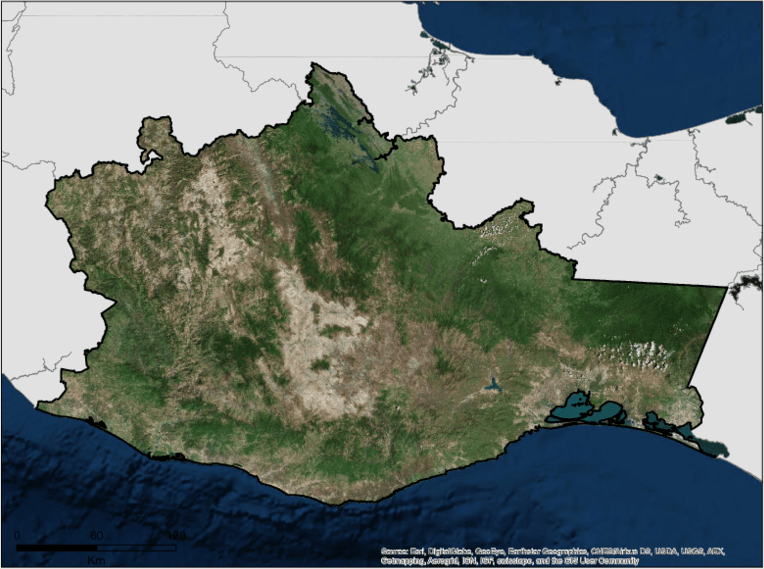
Description
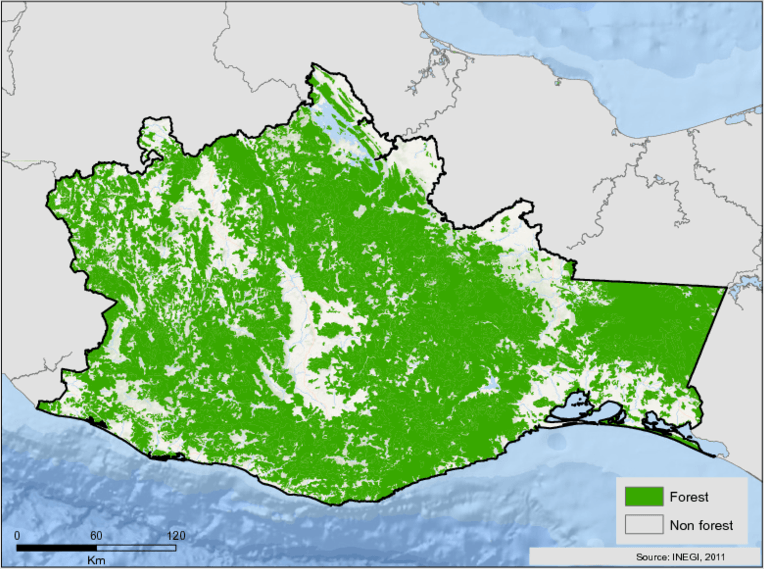
Oaxaca has an approximate area of 94,000 km2 making it the fifth largest state in Mexico (4.8 percent of the country’s total area). It is also the most biodiverse state in the country (García-Mendoza, Ordoñez, & Briones-Salas, 2004). Oaxaca is home to all eleven forest types identified by the national government (SEMARNAT, 2014)), and it has the third largest forested area in the country, with 6.2 million hectares (INFyS). It has one of the most important and extensive reserves of tropical forest in the Chimalapas region. 83 percent of the territory is in possession of agrarian communities (JCAO, 2015), which represent around 44.5 percent of the total population of the state (INEGI, 2014).
Oaxaca has an average annual production of 500,000 m3 of wood (fourth place nationally) and generates an annual economic income of approximately 50 million dollars and 60,000 jobs in indigenous communities (SEFIN, 2012a). The state is a national leader in the sustainable management of forests based on a community forestry, forest plantations, and environmental services model.
The predominant land use is forests (53 percent), followed by livestock (25 percent) and agriculture (16 percent), with 1,517 million hectares. Agriculture is mainly produced for self-consumption, with low levels of mechanization and productivity. Livestock in Oaxaca is primarily reared through small-scale production units.
The AFOLU sector contributes 42 percent of the total GHG emissions of the state (Government of the State of Oaxaca, 2015), 19,191 million tons of carbon dioxide equivalent (CO2e) in 2013. Oaxaca reports a forest loss of around 31,000 hectares per year (USAID 2017). The main causes of deforestation are forest fires and change of land use, caused mainly by agricultural activities, as well as forest disease. In terms of degradation of ecosystems, 37.9% of the territory shows slight degradation, 24.2% has severe degradation, and 21.7% of the State is not effected by degradation. As forest area has been reduced, agricultural areas showed the highest gain from 2002 to 2015 (29,500 hectares per year).
Given the effects on the environment of agricultural activities and its potential to reduce deforestation and at the same time increase productivity, a public policy is being developed with the aim of aligning the development objectives of the agricultural sector with the needs of producers and the rural population through the design and implementation of the State Strategy to Reduce Emissions from Deforestation and Degradation of Forests and Jungles (EEREDD +). EEREDD + is aligned with the legal framework with the aim of adopting an integrated territorial management approach. The strategy seeks to promote productivity in the rural sector while maintaining forest resources.
Summary
Demographics
Urban vs. Rural Population
| Category | % | |
|---|---|---|
| Urban | 52.70 | |
| Rural | 47.30 |
Ethnic Groups
| Group | % | |
|---|---|---|
| Zapotecos | 33.55 | |
| Mixtecos | 23.52 | |
| Mazatecos | 14.43 | |
| Chinantecos | 8.87 | |
| Mixes | 8.73 | |
| Chatinos | 2.83 | |
| Other | 2.13 | |
| Triquis | 1.27 | |
| Cuicatecos | 1.16 | |
| Huaves | 1.15 | |
| Nahuas | 0.89 | |
| Zoques | 0.48 | |
| Chontales | 0.46 | |
| Amuzgos | 0.41 | |
| Chochos | 0.12 |
Economy
GDP Breakdown
| Category | % | |
|---|---|---|
| Services | 61.20 | |
| Industry, Mining | 33.16 | |
| Agriculture, Forestry | 5.50 |
Forest Status
Major Vegetation Types
| Category | km² | |
|---|---|---|
| Secondary Coniferous | 15,239 | |
| Secondary Deciduous | 6,300 | |
| Secondary Mesophytic Foresty | 3,102 | |
| Primary Mesophytic Forest | 2,263 | |
| Conifer Forest Primary | 1,923 | |
| Primary Deciduous | 1,124 |
Forest Management
| Category | km² | |
|---|---|---|
| Ejido | 78,000 | |
| Protected Area | 3,383 |
Drivers of Deforestation
In the case of Oaxaca, the direct causes that are most responsible for conversion of forests are the expansion of agricultural lands, forest fires, plagues and forest diseases, and illegal logging (information collected in the workshops for the elaboration of the EEREDD + Oaxaca, 2016) (USAID, et al, 2016).
The analysis of changes and permanence in the coverage between 1993-2002-2015, carried out with the series II, III and V of INEGI (1993, 2002, 2015), shows that the forests and jungles of Oaxaca presented their highest rate of change in the period from 1993 to 2002 (-0.88 percent) representing a loss of 57,379 hectares per year, from 2002 to 2015 its rate was -0.21 percent (12,636 hectares), for the period from 1993 to 2015 the average rate of change was of -0.48 percent, this represents a loss of 30,940 hectares each year on average (USAID 2017).
In terms of degradation, the analysis shows that the change in land use is the main cause of degradation of ecosystems; at the state level, 37.9% present slight degradation due to change in use and 24.2% present severe degradation, 21.7% of the State does not present degradation (USAID 2017).
Deforestation Rates
Notes
| a. | Due to different methodological approaches and base years, Forest Status data fields may differ slightly. Data sources for each field are listed below. |
Sources
| 1. | |
| 2. | INEGI 2010 |
| 3. | |
| 4. | PNUD Mexico 2012 |
| 5. | INEGI 2011 |
| 6. | USAID 2017; Secretaría de Medio Ambiente, Energías y Desarrollo Sustentable |
Overview of Forest Monitoring and Measurement Systems
The monitoring of forests, as well as their emissions, continue to be isolated actions. However, thanks to the elaboration of public policy instruments such as POERTEO, the state is providing guidance on technical elements such as tracking deforestation rates and requiring different sectors to report their progress in the conservation, recovery, and management of forests.
Another document that has provided relevant information is the State Inventory of Forests and Soils (IEFyS) and a State Greenhouse Gas Inventory (IEGEI). Forest Management Units (UMAFORES), provide communities and ejidos with a framework for monitoring in areas with forest management programs that serve as assessments for forest carbon sequestration. In addition, the preparation of the State Strategy REDD + aims to create and consolidate the State Monitoring, Reporting, and Verification System, of the activities of the AFOLU sector, aligned and nested to the National MRV System.At the inter-institutional level, the Working Group for Monitoring Reporting and Verification (GT MRV) has been created. Its objective is to be a permanent technical-scientific body, composed of members of the public and private social sector, specialized in monitoring, reporting, and verification of GHG emissions from the AFOLU sector, through the development of three work axes, emission factors, activity and inventory data, reference level and reporting, to strengthen REDD + actions. The members, according to the Climate Change Law for Oaxaca, are people with a recognized track record and their participation in the MRV GT is in a personal and honorary capacity.
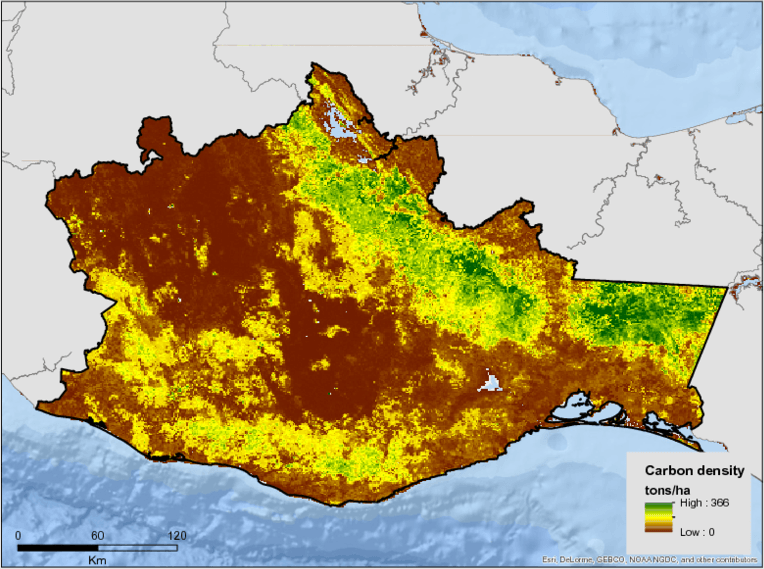
One of its functions is to guarantee the creation and operation of the MRV system of the EEREDD + Oaxaca, which will be able to estimate: i) GHG removals by forest sinks, ii) biomass and forest carbon stores and iii) changes in the forest cover.
Reference Levels and Targets
Deforestation Rates
Laws, Policies & Strategies
Strategies and Policies
Regional Ecological Planning Program of the Territory of the State of Oaxaca (POERTEO) – The POERTEO is an instrument for the planning of the territory through the promotion of sustainability criteria for different productive and anthropogenic activities. It integrates the main environmental problems and identifies the main productive sectors and relevant actors in each region through the definition of an Ecological Ordinance Model (MOE). The MOE is made up of 55 Environmental Management Units (UGA). Each UGA has its own ecological strategy and guidelines, including recommended use, conditioned uses, and non-recommended uses, as well as its importance according to biodiversity criteria, ecological regulation, its level of risk and its level of pressure. The MOE allows orienting of the productive activities in Oaxaca towards those areas with greater natural vocation that guarantee the success of the proposed activities.
State Program of Coastal Wetlands of Oaxaca (PEHCO)– Tool for the management, use, and conservation of the wetlands of the coast of Oaxaca; built with the participation of different community groups, organizations, and institutions in charge of conserving these ecosystems and represents an opportunity for the sustainable use of the biodiversity of the coast, for the economic and social development of the communities settled in this region.
The State Development Plan 2016-2022 (PED 2016-2022) – Governing instrument of the planning of the Government in the long, medium, and short terms, which reflects the aspirations and demands of society, and defines both the objectives and goals, as the strategies and lines of action that will guide decision making and public administration work, in collaboration with the different public and social sectors.
State Program on Climate Change – seeks to consolidate Oaxaca as a resilient state in the face of the effects of climate change, to ensure the conservation of natural capital, strategic infrastructure and cultural heritage, as well as to contribute to low-carbon economic development and the well-being of the population, considering gender equity and interculturality. (In the process of publication).
State Strategy for REDD + Oaxaca, (EEREDD +) of Oaxaca – The EEREDD + was built through a participatory and interdisciplinary process. Its objective is to reduce the emissions of greenhouse gases (GHG) from agricultural, forestry, and other land uses (AFOLU). With this, it seeks to avoid deforestation and degradation of the forests and jungles of the state, promote the conservation and increase of forest carbon stocks, and implement low-emission agricultural production models in the state of Oaxaca. It considers the causes of deforestation and degradation throughout the state context. The EEREDD + is linked to the National REDD + Strategy (ENAREDD +) through seven major complementary components: 1) public policies and legal framework; 2) financing schemes; 3) institutional arrangements; 4) monitoring, reporting, and verification (MRV) and reference level (NR); 5) social and environmental safeguards; 6) communication and capacity development; and 7) social participation and transparency. (Draft in publication process). The draft annex is available here.
Laws and Regulations
Decree No. 1396. 01/12/2010. Last reform 2/17/18 – Organic Law of the Executive Power – Establishes the bases of organization, powers, attributions, and functioning of the executive power, through the State Public Administration of Centralized and Parastatal, based on the provisions of the Political Constitution of the Free and Sovereign State of Oaxaca . It contemplates the functions and attributions of the Secretariat of the Environment, Energies and Sustainable Development (SEMAEDESO), as well as of the Secretariat of Agricultural Development, Fishing and Aquaculture (SEDAPA).
Decree No. 2068. 12/28/2013 – Law on Climate Change for the State of Oaxaca (LCCO) – Defines the powers to coordinate mitigation and adaptation actions to climate change, establishes concurrence mechanisms for actions related to climate change, and considers the gender approach, respect to human rights, the rights of indigenous and Afro-Mexican peoples, the participation of society and the strengthening of state capacities.
Decree No. 2004. 11/06/2013 – Sustainable Forest Development Law of the State of Oaxaca (LDFS) – Creates the State Forestry Commission (COESFO), with the objective of supporting the planning of forest sector development, the strengthening of community institutions and the promotion and consolidation of the productive forest chain, under criteria of conservation, protection and restoration of biodiversity and forest resources. This law promotes the integration of forestry and agriculture to increase the productivity and sustainability of the agrosilvícola system, and the promotion and consolidation of permanent forest areas, avoiding the change of agricultural land use.
Decree No. 1179. 09/04/2012 – State Law of Sustainable Rural Development – It contemplates the protection of the environment in the productive systems, the planning and organization of the agricultural production, its industrialization and commercialization and of the other goods, services and all those tending to elevate the quality of life of the rural population, as well as to promote the conservation of biodiversity and the improvement of the quality of natural resources, through its sustainable use.
Decree No. 266. 10/05/2008 – Law on the Rights of Indigenous Peoples and Communities of the State of Oaxaca – Establishes the obligations of the State Powers in their different spheres of government, regarding the rights and culture of the peoples and indigenous and Afro-Mexican communities; its provisions constitute the minimum prerogatives for the existence, survival, dignity, and well-being of these indigenous peoples and communities.
Institutional Framework
Ministry of Environment, Energy and Sustainable Development (SEMAEDESO) – Seeks to promote sustainable development in the state through the implementation of relevant public policies for the sustainable use of resources in the state with the minimum environmental impact, protection and conservation of natural resources, the preservation of the ecological balance, the mitigation and adaptation of climate change and the promotion of an environmental culture, considering social participation, inclusion, equity and equality. In charge of directing the policy on climate change and ecological ordering of the territory.
Ministry of Agricultural Development, Fisheries and Aquaculture (SEDAPA) – It is responsible to plan, regulate, and promote the agricultural, livestock, fisheries, and aquaculture development of the State, with the participation of productive and social organizations promoting land use planning under the hydrological basins, as well as criteria of regionalization and differentiated attention of the producers for a better focus of the policies of the sector. The SEDAPA promotes, coordinates, executes, and supervises the correct operation of the strategies of rural development and food security contributing to the sustainable development of the entity; as well as public policies, for the mitigation and adaptation to climate change and to encourage studies and research in this area, within the scope of its sphere of competence.
State Forestry Commission (COESFO) – Seeks to contribute to the welfare of the Oaxacans, through the economic and social environmental benefits generated by the orderly and sustainable management of forest ecosystems, with the impetus on the organization of the owners of forest resources, support for the planning of the development of the sector, the strengthening of community institutions, and the promotion and consolidation of the forest production chain, under criteria of conservation, protection, and restoration of biodiversity and forest resources, with a landscape management approach. Coordinates the implementation and implementation of the REDD + State Strategy.
Secretariat for Indigenous Affairs (SAI) – Responsible for formulating, organizing, promoting, monitoring, and executing policies and actions for compliance with the constitutional provisions on indigenous matters, international treaties, the Law on the Rights of Indigenous Peoples, and Communities of the State of Oaxaca and other corresponding legal systems. SAI implements, coordinates, executes, and evaluates plans, programs, projects, and actions for the sustainable integral development of indigenous and Afro-Mexican peoples and communities. SAI designs and implements the program of indigenous and Afro-Mexican peoples and communities for the mitigation and adaptation of climate change.
State Committee for Planning for the Development of Oaxaca (COPLADE) – Its institutional framework is to instruct the work related to planning for the preparation, formulation, and validation of the State Development Plan. COPLADE evaluates and proposes the parameters for the targeting of actions for sectoral, special, and institutional programs. It proposes and implements public policy priorities for State Development, with the aim of supporting the orientation of resources, the alternatives for their achievement, and the definition of corresponding performance goals. It formulates for approval the regions, micro-regions, municipalities, and localities that require priority attention, with the aim of focusing efforts on the State Public Administration to address the lags in the entity.
Zoning & Spatial Planning
The Program of Regional Ecological Planning of the Territory of the State of Oaxaca (POERTEO) arose from the recognition that population growth in Oaxaca represents a threat to the natural capital of the state and so a State Ecological Planning Program was necessary. The creation of this program seeks to balance the different productive anthropogenic activities and the protection of resources using sustainability criteria. To achieve this, the program recognizes the importance of maximizing consensus and the participation of the different actors in order to minimize conflicts, verify the information used, and validate the analysis and results. Additionally, POERTEO integrates the main environmental problems and defines the main productive sectors and relevant actors in each region. The integration of the document includes:
- The laws and regulations that support its preparation;
- The methodology used to elaborate the ordering model and the decision rules to define the elements of the program;
- The Ecological Ordinance Model (MOE), which defines 55 Environmental Management Units (UGAs), and;
- Recommendations and conclusions.
The POERTEO is integrated through the MOE, the ecological guidelines (for each UGA), and the ecological strategies. The MOE made it possible to focus the productive activities in Oaxaca towards those areas where the environmental impact is minimal while at the same time maximizing the characteristics for its realization. For the determination of the UGAs, four main statistics were used, (1) sustainable use (67.79% of the territory of the State), (2) Conservation with exploitation 14%, (3) restoration with utilization 13%, and (4) protection 2%
Additionally, POERTEO identifies the surface of each UGA, its importance by biodiversity criteria, its level of risk, and its level of pressure. The POERTEO presents the ecological guidelines for each UGA, including the recommended use, conditioned uses, non-recommended uses, those for which the UGA does not have aptitude, types of coverage to 2011, and guidelines to 2025 (where the vision of such area is presented for that year). Additionally, for each recommended sector, strategic actors are mapped to promote this sector.
In its ecological strategies, the POERTEO organizes the UGAs based on its policy and later on by sectors, defining the strategies that should be applied after the recommendation of a certain sector. Finally, the POERTEO relates the forty-nine criteria of ecological regulation with where the specific UGA would be applied. This includes a legal foundation (applicable federal and state laws) and ecological foundation.
The POERTEO is monitored through an online log, and includes the Territorial Ordinances of the Municipalities of Santa María Tonameca and Tututepec, belonging to the region of the coast of Oaxaca. There is also a Technical Committee that evaluates and monitors compliance with the POERTEO.
Engagement & Participation with Indigenous Peoples and Local Communities
The active and thriving involvement of the social sector and organized civil society have facilitated the creation of spaces for citizen participation supported by models of local governance for decision-making. This has led to decisions with inputs in a participatory, inclusive, intersectoral, and transparent way, with the intention of gathering the views of the owners, users and forest dwellers, businessmen, producer organizations and civil society, as well as of public officials. This was the case of the creation of the State Strategy REDD +. The citizens are focused on achieving the reduction of emissions from deforestation and forest degradation, maintaining and increasing the area covered by forests, and increasing the area of sustainably managed forests (REDD +).
Due to the multicultural conformation of the State of Oaxaca, the participation of priority communities and nuclei is necessary, not only through informed prior consultation procedures, but also through active participation in the planning, implementation, and implementation processes.
The forestry sector is organized through Natural Resources Committees, from different regions of the state, which are united in a State Union of Foresters of the State of Oaxaca (UESCO). The UESCO actively participates in the State Forestry Council, so that the decisions and public policy relating to natural resources, specifically forests, are carried out in a participatory manner.
One of the guiding principles of the EEREDD + is to seek social equality and opportunities, to generate well-being and favorable conditions for the participation of people in vulnerable situations, and to promote human rights.
It is important to comply with the safeguards recognized by international law and guarantee the free, prior and informed consent of ejidos, communities, and indigenous peoples. This includes recognizing the equitable distribution of benefits, the certainty and respect for property rights and legitimate possession and access to the natural resources of the owners and legitimate holders of the land, inclusion and territorial, cultural, social and gender equity, plurality and social participation, transparency and access to information and accountability, internal organizational forms, and the transversality, integrality, coordination, and complementarity between policies and instruments of the three levels of government.
Partnerships and Ongoing Initiatives
Specific Dedicated Mechanism for Indigenous Peoples and Local Communities of Mexico (MDE)
- Description
-
The Dedicated Mechanism (MDE) for Indigenous Peoples and Local Communities in Mexico is a special initiative of the Forest Investment Program (FIP), one of the three programs of the Strategic Climate Fund (SCF). The MDE supports efforts by developing countries to address the underlying causes of deforestation and forest degradation and to overcome the barriers that have impeded past efforts.
The goal of the MDE is to strengthen the capacities of people who depend on forests to participate in processes related to REDD + at the local, national, and international levels, in the selected states, in such a way that facilitates the address of the determinants of deforestation and degradation of forest lands and the implementation of good practices in different productive sectors, in order to catalyze the change towards a model of sustainable rural development low in CO2 emissions.
- Partners
- Indigenous Peoples and Local Communities of the states of Oaxaca, Yucatan Peninsula and Jalisco, Rainforest Alliance and the World Bank.
- Funding Amount
- USD 6,000,000
- Initiative Type
- Indigenous Peoples initiative
- Initiative Status
- In the final phase for publication of the call for applications to be funded
Forest Investment Program Dedicated Donation Mechanisms for Indigenous Peoples and Local Communities
- Description
-
The objective of the project is to strengthen the capacities of the people who depend on the forests of certain selected regions, to participate in local, national and international processes related to REDD +, as well as to recognize and support their rights of land tenure, management roles forestry and traditional forest management systems.
- Partners
- Rainforest Alliance
- Initiative Type
- Financial initiative
- Initiative Status
- Developing
EEREDD +
- Description
-
Control the agricultural frontier, reduce deforestation, and degradation and promote low-emission rural development.
Reduce GHG emissions
Reorient forestry and agricultural policy
Reduce incentives that promote deforestation and degradation
Increase incentives for conservation, management, restoration and sustainable use of forest resources
- Partners
- MREDD
- Funding Amount
- 350,000 MXN
- Initiative Status
- Completed
Euro-climate
- Description
-
There are three regional plans for the ordering and financial sustainability of tourism in ANPs, the Coast of Oaxaca, peaks of the neo-volcanic axis and northern Chihuahua and compliance with the Tourism standard to promote sustainable development.
- Partners
- European Community
- Funding Amount
- 500,000 M €
- Initiative Status
- Proposal
MDE-dedicated mechanism for indigenous peoples
- Description
-
The Dedicated Mechanism (MDE) for Indigenous Peoples and Local Communities in Mexico is a special initiative of the Forest Investment Program (FIP), one of the three programs of the Strategic Climate Fund (SCF). The MOU supports the efforts of developing countries to address the underlying causes of deforestation and forest degradation and to overcome the barriers that have impeded previous efforts.
The goal of the MDE is to strengthen the capacities of people who depend on forests to participate in processes related to REDD + at the local, national and international levels, in the selected states, in a way that facilitates the direction of the determinants. of deforestation and degradation of forest lands and the implementation of good practices in different productive sectors, in order to catalyze the shift towards a model of sustainable rural development low in CO2 emissions.
- Partners
- BM-RA
- Funding Amount
- 1,000,000 USD
- Initiative Status
- Developing
State climate change program
- Description
-
State program of CC, is the political subject of the state, financed by the BID and developed by the Mario Molina Institute.
Consolidate Oaxaca as a resilient state in the face of the effects of CC to ensure the ecological heritage.
Strategic infrastructure, and cultural heritage.
Contribute to the low CO2 economic development,
The welfare of the population.
Under the gender and intercultural approach.
- Partners
- IDB + FCS-WWF
- Funding Amount
- 200,000 USD
- Initiative Status
- Developed in the instrumentation phase