
Tabasco, Mexico
Mexico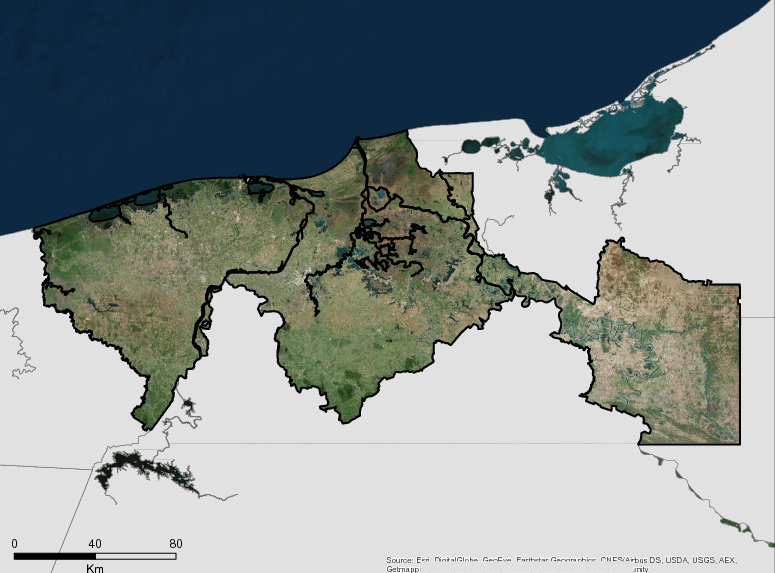
Description
Tabasco is located in the southeast region of the country, bounded on the north by the Gulf of Mexico (Atlantic Ocean), on the east by Campeche, on the southeast by Guatemala, on the south by Chiapas and on the west by Veracruz. According to the Political Constitution of Tabasco, the state is integrated by 17 municipalities, divided into two major regions and five subregions according to their geographical characteristics. In terms of area, Huimanguillo is the largest municipality and Paradise is the smallest; whereas according to the number of inhabitants, the most populated municipality is Centro and the least populated is Emiliano Zapata.
The state of Tabasco represents 1.26% of the country’s area. By 2015, the state of Tabasco was divided into 17 municipalities. 95.5% of the surface of the state presents a warm humid climate, the remaining 4.5% has a subhumid climate toward the eastern part of the state. The average state rainfall is 2,550 mm annually, rainfall occurs throughout the year and is more abundant in the months of June through October.
The hot humid climate favors the cultivation of banana, papaya, orange, lemon, coconut, cocoa, rice, maize and pepper, among others. The state of Tabasco has a large area of natural pastures, which favors the exploitation of cattle through the system of free grazing or extensive livestock. Due to their hardiness and tolerance to high temperatures, Zebu cattle are best adapted to the tropical climate of the state. Raising cattle is mainly aimed at obtaining meat, although dairy production is also important in the state.
Additional information can be found on the GCF Impact Platform.
Summary
Demographics
Urban vs. Rural Population
| Category | % | |
|---|---|---|
| Urban | 57.00 | |
| Rural | 43.00 |
Economy
GDP Breakdown
| Category | % | |
|---|---|---|
| Industry, Mining | 54.20 | |
| Services | 43.80 | |
| Agriculture, Forestry | 2.00 |
Forest Status
Forest Management
| Category | km² | |
|---|---|---|
| Ejido | 10,905 | |
| Protected Area | 3,617 |
Drivers of Deforestation
According to the Baseline for Tabasco for the conservation of carbon stocks, sustainable forest management and increase in carbon stocks developed by the Center for Global Change for Sustainability of the Southeast and the Government of the State of Tabasco, one of the main factors that influenced the processes of degradation and deforestation of the forests were the public policies that encouraged the clearing of the forests to transform them into agricultural lands and pastures. Dr. Fernando Tudela Abad, in 1989, carried out an analysis on the expansion of livestock activity in Tabasco between 1960 and 1975, concluding that there were more than 1 million head of cattle for 1970, which was achieved with an aggressive plan to clear the forests of the State. By 1980 more than half of the state surface had been converted into grasslands.
Among the main consequences of deforestation in Tabasco, which were already evident at that time, are: loss of biological wealth (estimated up to 300 plant species per hectare), emission of carbon dioxide (CO2) into the atmosphere and reduction in the capacity of capture, modifications in the climatic regime, increase of the run-off (flow of surface water), and transformations in the soil like loss of nutrients, erosion, compaction, salinization, and flooding in the plains.
In the last decade the processes of forest deforestation have increased, mainly because Tabasco, at the national level, is one of the cases of greater degradation and deforestation. In the State, a fragmented landscape can be observed, with remains of forest, which are subject to the influence of livestock and agricultural activities, social conflicts, new human settlements, problems of land tenure, extraction of illegal timber products, pests and forest diseases, fires, creation of new roads, as well as the uses and customs.
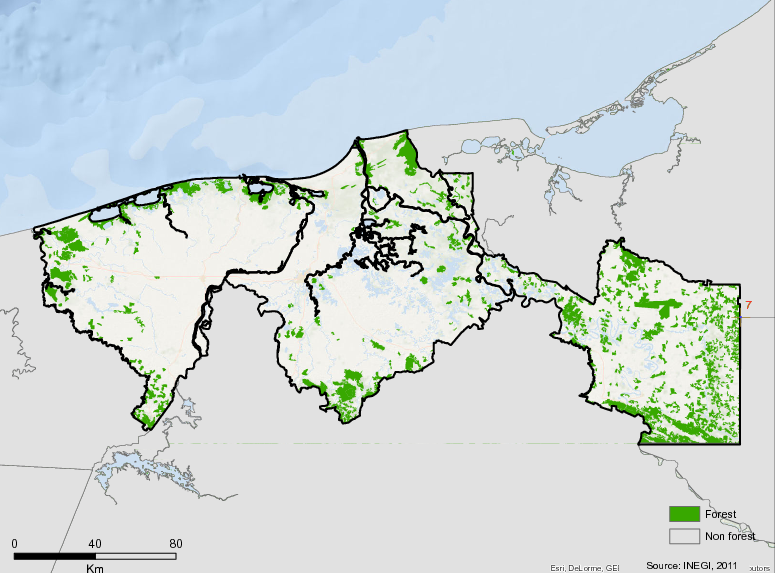
The current trends of deforestation and degradation are minor, since the greatest transformation in the State was carried out in the 1960s. Currently there is little natural forest surface remaining, which is not easily accessible, and is located in flood-prone areas. There has been a strong increase in forestry activities and there is positive data regarding the gain of forest areas.
Deforestation Rates
Notes
| a. | Due to different methodological approaches and base years, Forest Status data fields may differ slightly. Data sources for each field are listed below. |
Sources
| 1. | INEGI link |
| 2. | INEGI link |
| 3. | cuentame Inegi link |
| 4. | INEGI link |
| 5. | |
| 6. | INEGI link |
| 7. | Linea Base – tabasco |
| 8. | Tabasco REDD+ Assessment |
| 9. | http://osse.org.mx/Recursos/Investigaciones/Estad%C3%ADsticas/Propiedad-Social/Ejidos; Comisin Nacional de Areas Naturales Protegidas |
Overview of Forest Monitoring and Measurement Systems
The National Forestry Commission, CONAFOR, through the REDD + Strengthening Project and South-South Cooperation, worked to develop the National Forestry Monitoring System, which allows transparency and certainty to the REDD + actions that the country undertakes.
Reference Levels and Targets
Deforestation Rates
Sources
| 1. | Tabasco REDD+ Assessment |
Laws, Policies & Strategies
Strategies and Policies
State Program of Action to Climate Change (PEACC) – Seeks to define, analyze and propose the strategic measures needed to address climate change in Tabasco. PEACC utilizes mitigation measures (reduction of greenhouse gas emissions), and adaptation measures to ensure the integrity of communities and to develop capacities to deal with adverse impacts. As a result, PEACC is an instrument to support public policies and actions related to climate change within the state government’s sphere of competence, as well as to form an important element of the critical path for climate change policy in Mexico and Identify actions and measures to reduce vulnerability to the impacts of climate change and greenhouse gas (GHG) emissions.
Ecological Ordering Program – Acts as a basic normative instrument which guides the geographical location of productive activities, regulates land use, natural resource management and human activities as well as the modalities of use of resources and environmental services. The program provides a foundation of ecological policy, providing the legal, methodological, and technical elements for land use planning.
Laws and Regulations
Law of Sustainable Management of the Territory of the State of Tabasco 7/29/2015 – this Law is of public order, social interest, and of general application throughout the territory of the State of Tabasco, its provisions are intended to regulate the Territorial and Urban Planning, in a sustainable manner.
Law of Environmental Protection of the State of Tabasco 12/22/2012 – aims to regulate all types of activities to protect the environment through the establishment and application of environmental policy instruments, as well as to regulate those activities necessary when the environment has been damaged. It also contains a chapter on climate change, within which the policies of the REDD + strategy can be harmonized. Article 28 states that the state policy on climate change must promote adaptation and mitigation actions to combat global warming, where the principles of sustainable development are considered to contribute to reducing the risk of the population, their heritage, and the conservation of natural resources
Decree Modifying Ecological Criteria of the Ecological Program of the State of Tabasco 12/22/2012 – updates the State of Tabasco’s ecological zoning plan.
Forestry Law of the State of Tabasco 1/4/2006 – this law is intended “to regulate and promote the conservation, protection, restoration, management, and forestry exploitation, as well as the transfer of the results of scientific and technical research, organization, and training of producers, marketing”, among others, in order to contribute to sustainable forest development (Article 1). This law serves as a regulatory framework for the State Forestry Commission of Tabasco, whose objective is to promote productive activities, protection, conservation, and restoration in forestry. It also seeks protection, conservation, as well as the recovery of forest areas which is a priority of the State Government.
Institutional Framework
The Secretariat of Energy, Natural Resources and Environmental Protection (SERNAPAM) – has carried out projects to reduce greenhouse gases, strengthen local capacities, and develop research on issues related to climate change since 2002.
The Secretariat of Territorial Planning and Public Works (SOTOP) – is currently carrying out the updating of the Territorial Ordering Programs of the State.
The State Forestry Commission (COMESFOR) – has the function of protecting our forest resources, as well as promoting the restoration and the rational use of them, avoiding their deforestation and degradation.
Zoning & Spatial Planning
Tabasco’s State Program on Ecological Zoning (POET) is an instrument of state environmental policy used to regulate land uses of the territory (geographical location of productive activities), based on the current assessment of natural resources, the socio-productive condition of the area, and the suitability or potential of use of the analyzed site. POET considers elements of property and markets to determine the useful capacity of the territory with the lowest risk of degradation. Tabasco’s statewide zoning was originally completed in 2006, and has been updated two times since. The current zoning plan was completed in 2013.
Engagement & Participation with Indigenous Peoples and Local Communities
One of the principles of the State Government is equity in the implementation and application of public policies, with a gender, ethnic, participatory, and inclusive approach as established by the State Development Plan 2013-2018.
Rights of vulnerable groups are a priority for the State Government, which has created the Law of Indigenous Rights and Culture of the State of Tabasco. The Law aims to establish the obligation of State powers and City Councils or Municipal Councils to elevate the social welfare of Indigenous Peoples and their communities. In this legislation, the competent state and municipal authorities are instructed, among other things, to support the participation of indigenous groups in the execution of programs and public policies for the benefit of their communities, incorporating the representatives designated by the communities themselves with the purpose of strengthening indigenous participation in government, management, and administration in its different areas and levels.
However, the dynamics of globalization have influenced the level of the challenges that exist to actively integrate participation within public policies of ethnic groups, so the Government has sought to generate spaces for dialogue and agreement with the ethnic groups to overcome the disagreements. The government has sought to break the economic and social exclusion of marginalized communities and facilitate the contribution of indigenous peoples to the processes of defining development policies and strategies.
Likewise, the Law of Environmental Protection of the State of Tabasco highlights the importance of the participation of indigenous peoples for the protection, preservation, use and sustainable use of natural resources. This presents an opportunity for the development of reforestation programs in coordination with the indigenous communities.
Partnerships and Ongoing Initiatives
"Turnkey" strategy.
- Description
-
Reforestation support to small producers of pine and eucalyptus
- Partners
- CONAFOR, Government of the State of Tabasco
- Funding Amount
- 42 million pesos in 3 years
- Initiative Type
- Reforestation initiative
- Initiative Status
- In action
Creation of a REDD + Strategy for the State of Tabasco
- Description
-
In Tabasco, most of the land is used for agricultural and industrial purposes (85% of the territory), with remnants of forests on 5% of the surface and extensive areas underwater (popales and tulares) or covered by wetlands with aquatic vegetation. The state government has identified 282,240 hectares of forests that must be protected from deforestation and forest degradation in the southern highlands adjoining Chiapas and in the hills of the Tenosique-Balancan region. To solve the State’s REDD + problem, five activities are proposed, including landscape approaches to the conservation of carbon stocks, and the transformation of the landscape for carbon capture, and support activities to achieve a comprehensive approach in the assessment of financial needs, the design of a monitoring and evaluation framework, and the linking and dissemination. The general objective of the proposal is to decree a state REDD + strategy with an investment plan, agreed through a participatory process.
The first activity related to landscape conservation to maintain carbon stocks consists of two sub-activities; the design of a plan for the protection of carbon stocks in forests totaling 282,240 hectares, and the design of a work plan for the conservation of agroforestry systems totaling 55,990 hectares. The second landscape transformation activity for carbon capture is also made up of two sub-activities; the design of a work plan for the productive reconversion of livestock with silvopastoral systems and the design of a work plan for the establishment of commercial forest plantations with species native timber.
In terms of the theory of change, the first work activity would result in the conservation of the collections, avoiding the processes of deforestation and forest degradation. Secondly, silvopastoral systems and forest plantations are agents that would transform the landscape from a herbaceous level to others with different strata from undergrowth to arboreal canopies.
The third activity is based on an assessment of the financial needs to know the amount, type, and possible sources of national and international financing that would be needed for the implementation of REDD + actions in Tabasco. The fourth activity is the design of a monitoring and evaluation framework to establish the baseline and quantify future REDD + actions. The last activity ensures the link and dissemination for the participatory design and the promotion of a REDD + strategy in the State.
Adding all the hectares with a potential REDD + for the state of Tabasco, would amount to an estimated 2 million hectares, with actions that could be developed in a period of 2019-2024.
- Partners
- Government of the State of Tabasco – Conservation International Mexico
- Funding Source
- Norway
- Initiative Type
- Jurisdictional Planning
- Initiative Status
- Proposal Submitted
Declaration of a Protected Natural Area of Federal Character in the Mecoacán Lagoon to protect 18,000 hectares of mangrove
- Description
-
Protection of more than 18,000 hectares of mangroves along the coast of Tabascos
- Partners
- Government of the State of Tabasco, National Commission of Natural Protected Areas
- Initiative Type
- Public politics
- Initiative Status
- In process
Environmental Services of the Usumacinta Canyon.
- Description
-
The area of Environmental Services, in favor of the Conservation of natural protected areas, reforested 60 thousand hectares of the marshes of Centla and 56 thousand hectares of the Usumacinta Canyon.
- Partners
- CONAFOR, SEMARNAT
- Funding Amount
- 35 million pesos
- Initiative Type
- Initiative of pretegid areas
- Initiative Status
- Completed
Project of Environmental Management of protection to plantations by fires.
- Description
-
Installation of control cameras in strategic points to detect fires in a timely manner
- Partners
- Government of the State of Tabasco
- Funding Amount
- 32 million pesos
- Initiative Type
- Forest fire initiative
- Initiative Status
- In management
PROTEAK Initiative
- Description
-
Plant to manufacture medium density fiberboard, which includes 12,000 hectares of eucalyptus, teak and other timber species
.
- Partners
- PROTEAK (private sector)
- Funding Amount
- $ 200 million
- Initiative Type
- Financial initiative
- Initiative Status
- Completed
Rural forest restoration program
- Description
-
Extension of the CONAFOR Reforestation Program. Operative personnel of reforestation works.
- Partners
- Government of the State of Tabasco
- Funding Amount
- 17 million pesos per year
- Initiative Type
- Reforestation initiative
- Initiative Status
- Completed