
Yucatán, Mexico
Mexico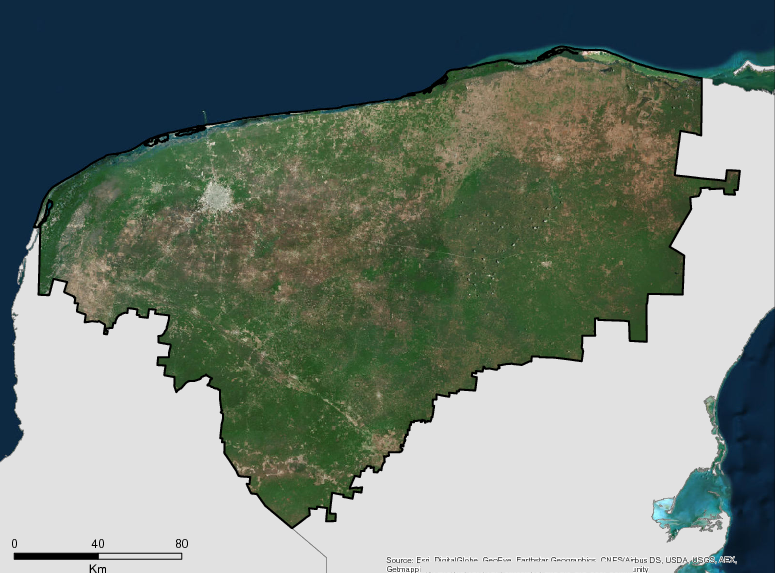
Description
Yucatán is a state located in the southeast region of Mexico, in what is known as the Yucatan Peninsula. Its territory has an area of 39,583 km2, which represents 2.02% of the nation. The predominant climate is warm subhumid with rain in summer, the average annual temperature is 26° C with an average maximum of 36° C and an average minimum of 16° C. It has a privileged geographical location between the Gulf of Mexico and the Caribbean Sea, which gives it great environmental and biological heterogeneity, which is reflected in the richness of its natural resources and biodiversity. About 26.09% of its territory (10,333.0016 km2) is under protected status.
In the socio-cultural sphere, the State has a strong influence from the Mayan culture, observed not only in the numerous archaeological vestiges, but also in the roots of local customs and traditions; and the presence of a considerable indigenous population. The economy of Yucatan is mainly based on the tertiary sector of trade which is the greatest contribution to the Gross Domestic Product (GDP) of the State, followed to a lesser degree by the industrial and construction sector; and the primary sector (agriculture and livestock).
More information can be found on the GCF Impact Platform.
Summary
Demographics
Urban vs. Rural Population
| Category | % | |
|---|---|---|
| Urban | 61.50 | |
| Rural | 38.50 |
Economy
GDP Breakdown
| Category | % | |
|---|---|---|
| Services | 64.30 | |
| Industry, Mining | 23.50 | |
| Agriculture, Forestry | 10.90 |
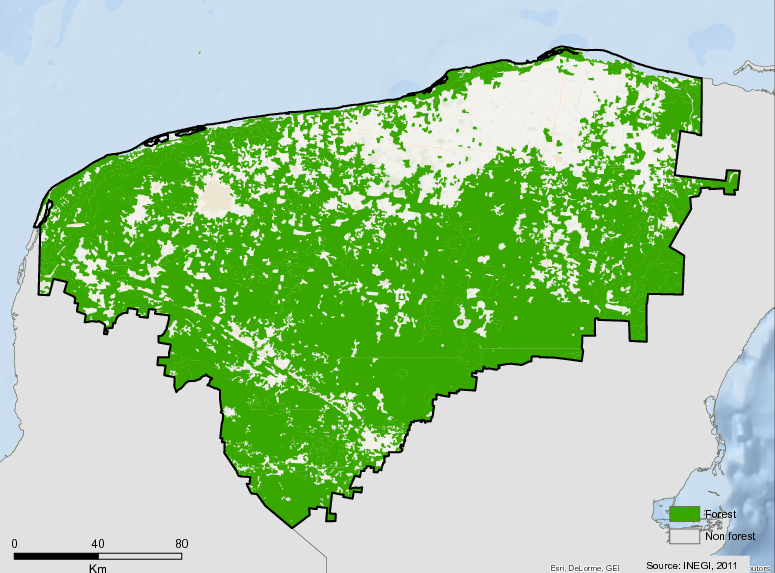
Forest Status
Major Vegetation Types
| Category | km² | |
|---|---|---|
| Primary Deciduous | 6,358 | |
| Secondary Sub-deciduous Jungle | 4,024 | |
| Secondary Deciduous | 2,052 | |
| Primary Perrenial | 629 | |
| Secondary Perennial Forest | 306 |
Forest Management
| Category | km² | |
|---|---|---|
| Ejido | 21,972 | |
| Protected Area | 6,319 |
Drivers of Deforestation
Yucatán ranks sixth nationally among the states with the most deforestation. In the last 24 years, it has lost approximately 30% of its vegetation cover. According to the information provided by recent studies conducted in the territory, the main causes of deforestation are associated with the growth of agricultural activities, where livestock contributes between 47 and 51% of the loss of plant cover, followed by rainfed agriculture with 33 to 36% and to a lesser extent mechanized agricultural expansion, forest fires, fruit expansion, human settlements, the expansion of road infrastructure, and agro-industry.
The loss of 2,849.5804 km2 of forests from 2005-2013, has had a high cost in ecological terms as well as economic and social profitability.
It is important to highlight that the causes of deforestation do not impact the State equally, since there is a spatial variation between regions as can be observed in the northeast of Yucatan where the predominant productive activity is livestock, compared to the Oriente region where the predominant activity is small-scale commercial agriculture and subsistence agriculture. This differentiation can be attributed to socioeconomic factors that have historically favored the prevalence of certain productive activities.
Deforestation Rates
Notes
| a. | Due to different methodological approaches and base years, Forest Status data fields may differ slightly. Data sources for each field are listed below. |
Sources
| 1. | Conociendo Yucatán Quinta Edición, INEGI 2016. |
| 2. | Mexico FREL link |
| 3. | Panorama sociodemográfico de México,INEGI 2015. link |
| 4. | FUENTE: INEGI. Censo de Población y Vivienda 2010. |
| 5. | |
| 6. | INEGI, 2015. Panorama sociodemográfico de Yucatán. Encuesta Intercensal 2015. 228 pp. |
| 7. | Yucatán, Informe PROMEXICO Inversión y Comercio, Secretaría de Economía, 2016. |
| 8. | Índice de Desarrollo Humano para las entidades federativas, México 2015. PNUD,2015. |
| 9. | Oportunidades de mercado para Yucatán 2009. SAGARPA,2009. |
| 10. | CONAFOR 2014 |
| 11. | INEGI/FCPF FREL |
| 12. | Elaboración propia con datos de la carta de uso de suelo y vegetación (INEGI, 2016). Homologado a los tipos de vegetación dispuestos en la tabla N°52 (categorías que se incluyen en tierras forestales) del documento de la Iniciativa de Reducción de Emisiones (IRE, 2016). |
| 13. | CONANP |
Overview of Forest Monitoring and Measurement Systems
Mexico currently has a proposal to measure and monitor changes in forest cover, through the National Monitoring, Registration and Verification System (SNMRV, created in July 2015), developed and implemented by the National Forestry Commission (CONAFOR), which is developing products and national protocols for activity data and emission factors. It is envisaged that this system will receive feedback from state experts to incorporate local data, develop state methodologies and make other types of improvements, so as to ensure coherence and transparency in the estimation of emissions between the states and national emissions.
To align itself with the SNMRV, the government of Yucatan has contemplated the creation of the State Forestry Information System (SEIF) that will have, as one of its objectives, the dissemination of information on forestry matters in the state. This system will be supported by a Monitoring, Reporting and Verification Working Group of Yucatán (GT-MRV Yucatán), which will be made up of specialists in activity data, emission factors and greenhouse gas inventories, in order to provide feedback and participate in the development of the components of the State MRV system.
Reference Levels and Targets
Deforestation Rates
Sources
| 1. | Rio Branco Declaration based on National FREL |
| 2. | INEGI/FCPF FREL |
Laws, Policies & Strategies
Strategies and Policies
Decree no. 176 5/26/2014 State Climate Action Plan (PEACC) – the Plan references the development of a regional strategy to reduce deforestation and highlights restoring degraded lands and promoting sustainable livestock production as a key strategy for reducing deforestation in the state.
It establishes the roadmap through 2030 for the reduction of greenhouse gas emissions and adaptation to the impacts of climate change. It presents a sector analysis of the main sources of greenhouse gas emissions, among which it points to land use, land use change, and forestry as the three main emitters of GHGs in the State, with a total of 1,334,300 Ton CO₂e issued annually representing 13% of the state total.
PEACC also provides for mitigation in order to promote the low emission development and conservation of the carbon sink potential of protected natural areas of the State, and strategies and lines of action aimed at the sustainable management of agricultural soils, the improvement of vegetation cover in grazing lands, the promotion of agroforestry systems and conservation agriculture, the promotion of reforestation, and sustainable forest management, among others.
State Development Plan –The State Development Plan is an instrument of government built by adding the voices of all citizens; It defines what the Government will do in the next six years. All actions, programs, public works, budgeting, investment and government expenditures will have to be justified, aligned and supported by the objectives, strategies and indicators that are set out here and that from now on become Law. The State Development Plan is the map that tells us where we want to arrive in 2018 and what we should do to not deviate from that route.
FCPF Carbon Fund Investment Program – Yucatán has developed an investment program to reduce deforestation through Mexico’s Emissions Reduction Initiative implemented under the framework of the Forest Carbon Partnership Facility.
State REDD+ strategy (EEREDD+) – Currently the State of Yucatan has a draft version of the State Strategy for Reducing Emissions from Deforestation and Forest Degradation (EEREDD +), prepared in 2015 with resources from the federation of the Secretariat of Natural Resources and Environment (SEMARNAT). During the period of 2016 – 2017, it was submitted to several processes of participatory feedback with key actors from the three levels of government, the academic sector and research, as well as civil society organizations and representatives of rural and indigenous communities located in key municipalities for forest conservation; that resulted in the updating of this climate policy instrument. Its approval in 2018 is in process before the Interministerial Commission of Climatic Change of Yucatán, preceded by the constitutional governor of the State, which acts as an organ of consultation, coordination, agreement and evaluation of the public policies established for the prevention and mitigation of greenhouse gas emissions and adaptation to climate change in Yucatan.
Laws and Regulations
Decree no. 466 6/8/2017 – Law establishing sustainable forest development in the state of Yucatan.
Decree no. 537 10/31/2017 – By which the apicultural zones of the state of Yucatan are established for the promotion of their rational use. Decree by which a zoning is established for the promotion of beekeeping in the state, based on the state of deterioration or conservation of the predominant environmental services in the different regions of the state.
Decree no. 418 10/26/2016 – Decree declaring the state of Yucatán as a free zone of agricultural crops with genetically modified organisms. To protect the environment and the health of Yucatecans, the State Government declared this entity as free of genetically modified organisms, since several studies indicate that technological packages, in addition to pesticides and herbicides linked to these procedures, cause diseases to the human being as well as to the flora and fauna.
Decree no. 39 2/15/2013 Sustainable Rural Development Law – Promotes an integrated development framework for rural areas in the state and regulates the planning and organization of agricultural development in the states.
Decree no. 402 5/19/2011 Law for the Protection of Fauna of the State of Yucatan – Establishes the normative bases for the protection and the natural development of the fauna that are in the State of Yucatan.
Decree no. 333 5/25/2010 Environmental Protection Law – Outlines the State’s environmental policy instruments and defines institutional arrangements for the protection and management of environmental resources in Yucatan. In lieu of a forestry law the Environmental Law governs sustainable forestry development and protected areas.
Decree no. 297 6/3/2010 Establishing the Inter-Secretariat Commission on Climate Change of Yucatán – Establishes the commission’s purpose to coordinate the actions of the agencies and entities of the State Public Administration related to the formulation and implementation of public policies for the prevention and mitigation of greenhouse gas emissions and adaptation to reduce the vulnerability of adverse impacts of climate change in Yucatan.
Decree no. 96 7/14/2008 Creating the Forest Council of the State of Yucatán – This decree establishes the Forestry Council of the State of Yucatan as an institution of consultation, advice and agreement that has the purpose of contributing to the planning, supervision and evaluation of the policies of exploitation, conservation and restoration of the forest resources of the State of Yucatan.
Decree no. 793 7/26/2007 – Formalizes the Ecological and Territorial Ordering Program of the State of Yucatán (POETY)
Decree no. 125 6/30/1995 Law of Human Settlements of the State of Yucatan – Law that establishes the norms according to which the State and the municipalities will participate in the organization and regulation of human settlements.
Institutional Framework
Rural Development Secretariat of Yucatán (SEDER) – Responsible for planning related to agriculture and forestry, including extension services for local producers.
Urban Development and Environment Secretariat (SEDUMA) – Responsible for developing and implementing environmental policy, overseeing natural resources management and conservation and promoting protected areas. Responsible for addressing drivers of deforestation and implementing REDD+.
Forest Council of the State of Yucatán – On September 12, 2008, the Forest Council of the State of Yucatan was created whose objectives include: Assist in the formulation of the State’s forestry policy, based on the guidelines established by the State Development Plan; Prepare the Forestry State Program project and submit it to the Executive Power Holder for review and approval, as appropriate; Promote coordination between government orders and sectors of society and encourage their participation in the actions carried out for the conservation and restoration of forest resources; Promote coordination with the Councils for Sustainable Rural Development; Issue an opinion regarding forest management programs and changes in land use in forest lands; among other duties.
State Intersecretarial Climate Change Commission (CIClima) – Inter-institutional platform developed to validate the Investment Programs to reduce deforestation. Comprised of the Secretary of Budget and Planning, Secretary of Health, Secretary of Education, Secretary of Community and Social Policy, Secretary of Public Works, Secretary of Economic Development, Secretary of Tourism Promotion, Secretary of Promotion of Agriculture and Fisheries, and the Secretary of Urban Development and the Environment.
Zoning & Spatial Planning
The state has different territorial arrangements made at different scales. The zoning and state planning in Yucatan is based on the following types of ordering:
Ecological Planning of the State Territory (POETY)
The overarching zoning is done through the Territorial Ecological Ordinance Program of the State of Yucatan (POETY), which aims to regulate land uses, the use of natural resources, productive activities and urban development, in order to to make compatible the conservation of the biodiversity, the protection to the environment and the sustainable use of the resources and natural elements with the urban and rural development of the state of Yucatan, as well as with the economic activities that are carried out, serving as a base for the elaboration of the programs and development projects that are intended to be executed in the state territory.
Through the present Program of Ecological Regulation of the Territory of the State of Yucatan, the “Model of Territorial Development” or “Model of Occupation of the Territory” for the State of Yucatan is established, based on criteria of rationality and balance between ecological efficiency and the socio-economic development of the territorial system.
The Territorial Development Model is a spatial projection of a strategy of economic and social development that contributes to the design of the future territorial system and to the way in which it can be achieved, representing the way of specifying spatially the environmental objectives proposed in terms of sustainability.
The model includes the proposal of uses for the territory, according to its potential and limitations and the establishment of a system of environmental policies and criteria for use, protection, conservation and restoration that guarantee the rational exploitation and conservation in the medium and long term of the natural and human resources of the State.
The model considers the protection of nature by assigning each area a specific functional value and an exploitation and transformation regime that implies conservation measures. Its construction reflects the need to reduce socio-spatial inequalities and the sustained increase in the quality of life of the population residing in the state.
Ecological Management Program of the Coastal Territory of the State of Yucatan (POETCY)
Likewise, the Ecological Management Program of the Coastal Territory of the State of Yucatan (POETCY) has been promulgated and is an instrument of legal planning, based on technical and scientific information, which determines regulatory schemes of territorial occupation that maximize consensus among the social actors and minimize the conflict over land use. It establishes a series of legal provisions that induce the use of innovative public participation mechanisms, as well as the use of techniques and procedures of geographic analysis, information integration and environmental assessment. This process requires the development of new environmental management and evaluation capacities in the three levels of government.
The elaboration of the program was based on general principles that have been proposed to manage the coastal areas of the world. These principles were established by the United Nations Environment Program (UNEP), the International Union for Conservation (IUCN), the Convention on Biological Diversity (CBD), Agenda 21, the Organization for Economic Cooperation and Development (OECD), the Convention on Wetlands of International Importance, especially as Waterfowl Habitat (Ramsar), as well as the experience of other National Coastal Ordinances. These principles are: integration and interrelation, inter and intra-generational equity, the right to development, environmental care, precautionary measures, internalization of costs and transparency.
Community Territorial Ordinances (OTC)
Also, on a much more precise scale, there are numerous Community Territorial Ordinances (OTC) that have been carried out by the ejidal nuclei throughout the State of Yucatan.
These instruments are not yet recognized by the applicable laws, therefore they have a voluntary nature and their scope is only within the particular community in question, endorsed by the ejidal assemblies.
Engagement & Participation with Indigenous Peoples and Local Communities
The government of the State has promoted, through instances such as the Intercultural Biocultural Board of Puuc (JIBIOPUUC), the participation of rural and indigenous communities of Yucatan in the policy it directs to address the causes of deforestation and forest degradation through the development of participatory feedback workshops in key municipalities that are located in the implementation area of the Emissions Reduction Initiative (IRE) and the EEREDD + of Yucatán.
Likewise, through this instance, the strengthening of local capacities has been promoted in topics such as respect for the rights of indigenous peoples, good forest governance, protection of biodiversity, the gender perspective, the right to access information, transparency, binding to the context of REDD + safeguards through the importation of workshops with community representatives from the municipalities of Muna, Oxkutzcab, Santa Elena, Peto, Tekax, Ticul, Tzucacab and Yaxcaba, which make up the implementation area of the IRE and the EEREDD + of Yucatán.
The state has also pursued the development of agreements at the community level with key actors for the development of projects such as:
Integration of the Mayan Community Council of the Biocultural State Reserve
Convocation and participatory and inclusive conformation of the Council with representatives of the municipalities of Muna, Oxkutzcab, Santa Elena, Tekax and Ticul with the aim of contributing to the development of a protocol and regulation for the integral management of the territory and sustainable use of natural resources
Agreement for the conservation of 1000 hectares of forest in concurrent funds SEDUMA- CONAFOR in the municipality of Tekax, ejidos of Poccheil and Mocontún.
Three-year financing initiative that aims to conserve the natural resources of the municipalities that make up the Biocultural Region of Puuc, and the promotion of low-carbon productive activities.
Pilot project for the establishment of the intensive silvopastoral system of the Local Livestock Association of Temozón.
Initiative for the establishment of the intensive silvopastoral system of the Local Livestock Association of Temozón in 114 hectares located in 26 ranches. Completed in December 2017.
Reciprocal environmental agreement with the ejido Corral, municipality of Tzucacab to carry out actions in the matter of conservation of natural ecosystems with productive restoration in degraded areas
Initiative that promotes actions of conservation of natural ecosystems with productive restoration in degraded areas with impact in 1,928.34 hectares.
Reciprocal environmental agreement with the Cattle Association Local (AGL) of Catmis, municipality of Tzucacab to carry out actions in the matter of conservation of natural ecosystems with productive restoration in degraded areas.
Initiative that promotes actions of conservation of natural ecosystems with productive restoration in degraded areas with impact in 9,275.2 hectares.
Environmental reciprocal agreement with civil society Nukuch Ka’ax in the ejido Becanchen, municipality of Tekax to carry out actions in the field of conservation of natural ecosystems with productive restoration in degraded areas
Initiative that promotes actions of conservation of natural ecosystems with productive restoration in degraded areas with impact in 10,392,2446 hectares.
Finally, the State has promoted the creation of other spaces for social participation within the framework of implementation of the REDD + Mechanism at the subnational level, through the Technical Advisory Council for the Reduction of Emissions from Deforestation and Degradation of the State of Yucatán (CTC-REDD + YUC) . Which serves as an instance of consultation for the participatory and inclusive construction of the policy that directs the state and the federation in the rural area to address the causes of deforestation and mitigation of climate change. Where indigenous groups, forestry producer organizations, civil society organizations, rural sector organizations, educational and research institutions participate.
Partnerships and Ongoing Initiatives
ASPY: Business declaration for the Sustainability of the Yucatan Peninsula.
- Description
-
It is a voluntary declaration signed in December 2016, which emanates from the desire of the companies to move towards a responsible operation with the environment and the communities, to the extent of their areas of action, as a support to the fulfillment of the goals set in the ASPY signed by governments. In this Declaration, the signatory companies agree with the importance of “diminishing and reversing the loss of forests and jungles, promoting the sustainable use of biodiversity, while increasing the productivity and profitability of primary activities […] as well as a balanced development of secondary and tertiary activities “. On November 29, he makes his second annual progress report in Campeche.
- Partners
- Private companies of the Yucatan Peninsula
- Initiative Type
- Private Partnership
- Initiative Status
- In action
Climate Change Fund of the Yucatan Peninsula
- Description
-
The Climate Fund of the Yucatan Peninsula was established in 2016 in association with the three Autonomous Universities of Campeche, Quintana Roo and Yucatán. State governments participate as members of the fund’s Advisory Council, which has the mission of supporting regional initiatives to mitigate and adapt to climate change by financing regional climate priorities. It will also seek to be a regional counterpart in the REDD + payment scheme of the FCPF Carbon Fund, in coordination with CONAFOR. This fund began operating in December 2016, in phase 1, developing the executive plan to implement the trust, coordinating the operational strategy of the Advisory Board, designing the fundraising plan and the procedures manual. This Fund is a trust that can capture and distribute resources at the regional and state level, so that it can receive private and international resources for the development of climate policy actions
- Partners
- The Nature Conservancy and the state governments of Quintana Roo, Campeche and Yucatán, Autonomous Universities of Campeche, Quintana Roo and Yucatán
- Funding Amount
- USD $ 400,000.00
- Initiative Type
- Financial initiative
- Initiative Status
- In action
Forest Investment Program Dedicated Grant Mechanisms for Indigenous Peoples and Local Communities
- Description
-
The objective of the project is to strengthen the capacities of the people who depend on the forests of certain selected regions, to participate in local, national and international processes related to REDD +, as well as to recognize and support their rights of land tenure, management roles forestry and traditional forest management systems.
- Partners
- Rainforest Alliance
- Initiative Type
- Financial initiative
- Initiative Status
- Developing
Inter-municipal Board of the Puuc region of Yucatan
- Description
-
The Intercultural Biocultural Board of Puuc is an association of municipalities constituted as Intermunicipal Decentralized Public Organism (OPDI) that is created by agreement of the municipal councils that conform them.
This model arises from the recognition that local areas and municipal governments are ideal spaces for the resolution of problems of development and management of natural resources. The establishment of alliances between municipal authorities and actors linked to local development facilitates the management of the territory, cooperation, shared agreements and the recognition that environmental problems transcend the limits of the municipalities.
The objective of the meetings is to provide technical support to the member municipalities for the preparation, management and implementation of projects and programs related to the environment and natural resource management that have application in their territories.
- Partners
- City Councils of Tekax, Oxkutzcab, Santa Elena, Ticul, Muna, Tzucacab, JibioPuuc, SEDUMA, AFD, TNC.
- Funding Amount
- $ 1,500,000.00
- Initiative Type
- Decentralized Public Organization
- Initiative Status
- Developing
Milpa Maya Program
- Description
-
The Special Concurrent Program of the Maya Milpa Regions and Area of Influence of the State of Yucatan recognizes the historical, environmental, social, economic, cultural and legal factors that affect the milpa as a form of production and reproduction of the Maya community in the State of Yucatan. It identifies and develops proposals to improve living conditions and increase levels of well-being for Mayan families. The Milpa Program of the Milpera Region and area of influence has the purpose of guaranteeing and promoting the responsible and efficient use of the ecosystem services that ecosystems provide to society and whose benefits are distributed as widely as possible for human well-being.
- Partners
- State Government units that make up the Intersecretarial Commission for Sustainable Rural Development; State Council for Sustainable Rural Development.
- Initiative Type
- Indigenous Peoples Initiative
- Initiative Status
- Integration of the Intersecretarial Commission for Sustainable Rural Development and budget programming for 2018.
Payment for Ecosystem Services Concurrent Funds Program
- Description
-
Initiative for financing joint participation with the National Forestry Commission (CONAFOR) and SEDUMA for three years, whose objective is the conservation of natural resources and the promotion of productive activities low in carbon, in the ejidos of Mocontún and Poccheil, in the municipality of Tekax, Yucatán, which is part of the implementation area of the Emissions Reduction Initiative (IRE).
- Partners
- SEDUMA-CONAFOR, JibioPuuc, Ejido Poccheil and Ejido Mocontún
- Funding Amount
- $ 2,000,000.00
- Initiative Type
- Payment for Ecosystem Services
- Initiative Status
- Developing
Regional Safeguards Committee
- Description
-
The Safeguards Committee of the Yucatan Peninsula was formally installed on September 12, 2016, as a one-of-a-kind social participation platform, for specializing in giving feedback and providing inputs on the approach and respect of REDD + safeguards from a perspective regional.
The Committee is composed of representatives of communities, producer organizations, indigenous groups, civil society organizations, academia, and government agencies of the three levels of government.
Among its main functions, it contributes to the feedback of the national processes for the construction of the National Safeguards System (SNS) and the Safeguard Information System (SIS), collaborating closely with the National Forestry Commission (CONAFOR) and its delegations in the Yucatan Peninsula. Likewise, it provides support to the States of the Yucatan Peninsula in the feedback of the REDD + State Strategies and public policies associated with the approach and respect of the REDD + safeguards. Seeking to issue recommendations through bodies such as the Regional Commission on Climate Change of the Yucatan Peninsula, responsible for coordinating efforts and resources to undertake regional initiatives for mitigation and adaptation to climate change.
- Partners
- OSC, representatives of the academy of the three States of the Yucatan Peninsula, representatives of the, the state governments of Quintana Roo, Campeche and Yucatán, The Nature Conservancy,
- Initiative Type
- Public Private Partnership
- Initiative Status
- In action
State Agricultural Diversity Program
- Description
-
The purpose of this program is to provide economic and in-kind support to members of a Mayan community or a committee of users of biocultural landscapes. The support is based on the agreements they propose to form the working group or the user committee in which there is at least 50% of the participation of women, as well as the plan of use that the groups present, considering the works, practices, equipment and supplies required to ensure the production, processing, transportation and marketing of organic products.
- Partners
- Secretary of Urban Development and Environment.
- Funding Amount
- $ 2,500,000.00
- Initiative Type
- Financial initiative
- Initiative Status
- Developing
State Safeguards Plan of the State of Yucatán
- Description
-
This is a public policy instrument aligned with the implementation of the State REDD+ Strategy that seeks to address the potential social and environmental risks derived from the implementation of sustainable rural development actions in the territory, in accordance with the provisions of the UNFCCC Framework Convention on Climate Change, the United Nations Framework Convention on Safeguards and the national provisions relating to the National Safeguards System (SNS) and the Safeguards Information System (SIS). Priority topics include good forest governance, respect for the rights of local communities and indigenous peoples, protection of biodiversity and the sustainability and integrity of emissions.
This instrument seeks to delimit the applicable legal framework in the field of human rights, transparency and access to information, indigenous peoples, environment, sustainable rural development, sustainable forest development, as well as the institutional and compliance framework that allows to successfully address the social and environmental risks identified in the state regarding the implementation of REDD+.
- Partners
- State agencies such as the Ministry of Urban Development and the Environment (SEDUMA), Ministry of Rural Development (SEDER), Institute for the Development of Mayan Culture of the State of Yucatan (INDEMAYA), Institute for Equality between Women and Men in Yucatan (IPIEMH); Secretariat of Planning (SEPLAN). Including the participation of CSOs such as the World Bank, Pronatura, among others.
- Initiative Type
- Indigenous Peoples Initiative
- Initiative Status
- Under development
Value Chain Cheese and Milk of the
- Description
-
Strengthening of the value chain dairy products: milk and cheese from silvopastoral systems of the biocultural region of Puuc.
- Partners
- Local Livestock Association of Catmis, Tzucacab, JibioPuuc, TNC
- Funding Amount
- $ 500,000.00
- Initiative Type
- Financial Initiative
- Initiative Status
- Developing
Yucatan Peninsula Climate Fund
- Description
-
The Yucatan Peninsula Climate Fund was established in 2016 in partnership with the three Autonomous Universities of Campeche, Quintana Roo and Yucatan. The state governments participate as members of the Advisory Council of the fund which has the mission of supporting regional initiatives to mitigate and adapt to climate change by funding regional climate priorities. It will also seek to be a regional counterpart in the REDD+ payment scheme of the FCPF Carbon Fund, in coordination with CONAFOR. This fund started operations in December 2016, in phase 1, developing the executive plan to implement the trust, coordinating the operational strategy of the Advisory Council, designing the fundraising plan and the procedures manual. This Fund is a trust that allows the capture and distribution of resources in a regional and state way, so that it can receive private and international resources for the development of climate policy actions.
- Partners
- The Nature Conservancy, state governments of Quinatana Roo, Campeche and Yucatan, Autonomous Universities of Campeche, Quintana Roo and Yucatan
- Funding Source
- Private and International Funding including the FCPF Carbon Fund
- Initiative Type
- Financing Initiative
- Initiative Status
- Development of Executive Plan (first phase of implementation)
Yucatan Peninsula Framework Agreement on Sustainability for 2030 (ASPY 2030)
- Description
-
The ASPY strengthens collaboration among subnational governments to facilitate the transition and compliance with the Paris Agreement, the Bonn Challenge, the Rio Branco Declaration and the Aichi Targets, among others. The implementation of the ASPY 2030 will occur through the Regional Commission on Climate Change, formed through the first regional agreement on climate change signed at COP16 in 2010, and supported by initiatives of NGOs such as the Mayan Forestry Observatory that generate inputs for the forest policy.
The ASPY aims to conform through a transparent process, the Promotor Council of the Agreement for the Sustainability of the Yucatan Peninsula (ASPY 2030) as an advisory, interlocution and regional consultation body.
The agreement consists of 6 goals I. Achieve zero net deforestation in the year 2030 (with an interim step of reducing 80% – eighty percent – of gross deforestation by 2020). II. Restore two million terrestrial hectares, including: a. Sustainable intensification of agricultural production in 250,000 hectares in agricultural lands. b. Sustainable intensification of livestock in 250,000 hectares in agricultural land. c. Reforestation and restoration actions of degraded forests in 420,100 hectares. III. Achieve that 50% of the land and coastal territory of the Yucatan Peninsula is under conservation and / or forest management schemes. IV. Promote Mayan biocultural landscapes, in at least 5,484,000 hectares. V. Attract resources from private and / or international sources that represent the equivalent of the investment of public resources currently allocated to activities that promote the green economy and seek its progressive increase. SAW. Restore 20% of the reef crests (54 km) and 30% of the beach systems – coastal dunes altered by human settlements (80 km) that protect human communities, beaches and infrastructure
And it contemplates 8 components of implementation: I. Sustainable agricultural development II. Effective management of jungles III. Conservation of ecosystems IV. Water and ecosystems V. Sustainable management of coastal zones VI. Sustainable fishing VII. Promotion of green and responsible markets. VIII. Sustainable tourism
ASPY also has the support of a Declaration of the Private and Financial Sector, in which 70 companies of great impact in the region have expressed their interest in contributing to social and environmental responsibility with corporate sustainability, which will strongly contribute to the achievement of the objectives of the Agreement of Governors of the Yucatan Peninsula, ASPY 2030.
- Partners
- The Nature Conservancy and the state governments of Quintana Roo, Campeche and Yucatán, Autonomous Universities of Campeche, Quintana Roo and Yucatán
- Initiative Type
- Public Private Partnership
- Initiative Status
- Insubstantiated by sentence of a federal collegiate court
Yucatan Peninsula Framework Agreement on Sustainability for 2030 (ASPY 2030)
- Description
-
At COP 13 of the Conventions on Biodiversity held in Cancun in 2016, Quintana Roo, the Governments of the Yucatan Peninsula signed a collaborative work plan for 2030 called “Agreement for Sustainability of the Yucatan Peninsula” (ASPY 2030). This agreement strengthens collaboration among subnational governments to facilitate transition and compliance with the Paris Agreement, the Bonn Challenge, Rio Branco Declaration and the Aichi Goals among others. The implementation of the ASPY 2030 will occur through the Regional Climate Change Commission, formed through the first regional agreement on climate change signed at COP16 in 2010, and supported by NGO initiatives such as the Mayan Forest Observatory which generate inputs for forest policy. ASPY 2030 covers 8 components, each with specific lines of action:
- sustainable agricultural development;
- effective forest management;
- ecosystem conservation;
- water and ecosystems;
- sustainable coastal management;
- sustainable fisheries;
- green and responsible market development; and
- sustainable tourism.
ASPY is also supported by a Declaration of the Private and Financial Sector, in which 70 companies of great impact in the region have expressed their interest in contributing social and environmental responsibility towards corporate sustainability, which will contribute strongly to achieving the goals of the Agreement of Governors of the Yucatan Peninsula, ASPY 2030. The Governors of ASPY 2030 are: Mr. Rolando Zapata Bello, Governor of Yucatan, Mexico; Lic. Carlos Joaquín González, Governor of Quintana Roo, Mexico and Lic. Rafael Alejandro Moreno Cárdenas, Governor of Campeche, Mexico.
- Partners
- State governments in collaboration with private sector actors, civil society and the federal government
- Initiative Type
- Public Private Partnership
- Initiative Status
- Development phase (implementation plan finalized in June 2017)
Yucatan State Government Carbon Management Program
- Description
-
The Government of the State of Yucatan’s Carbon Management Plan (PGC) is an instrument that establishes the strategy and action plan to reduce GHG emissions generated directly or indirectly by the use of fossil fuel based energy in government-owned buildings by 10% by 2020 compared to 2015. This will be achieved through the implementation of energy efficiency projects and public servants’ awareness of energy efficiency and employment of technologies for the use of renewable energies. The Yucatán Carbon Management Plan (PGC) was funded by the British Government in Mexico through the Prosperity Fund in 2016 to receive specialized technical assistance from the international non-profit organization The Carbon Trust. This initiative also receives resources from the Future Fund of the State & Regions Alliance, an international alliance of local governments against Climate Change, in which the Government of the State of Yucatan has been a part since 2016, in order to establish the Monitoring, Reporting and Evaluation System of the Carbon Management Plan.
- Partners
- The British Embassy Energy Initiative (Prosperity Fund); State & Regions Alliance (Future Fund)
- Funding Source
- The British Embassy Energy Initiative (Prosperity Fund); State & Regions Alliance (Future Fund)
- Initiative Type
- Energy Initiative, Technical Assistance Partnership
- Initiative Status
- Implementation of the “Sustainable Footprint” program to develop actions of the Carbon Management Plan and MRV development.