
Loreto, Peru
Peru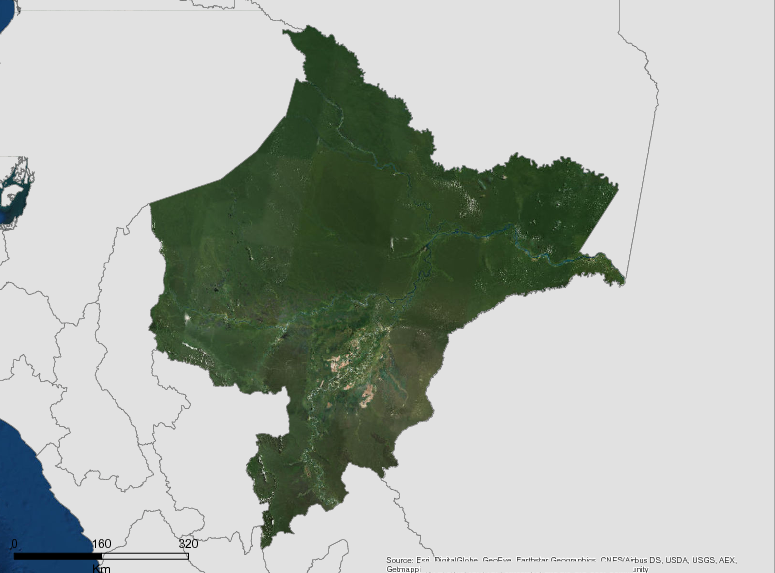
Description
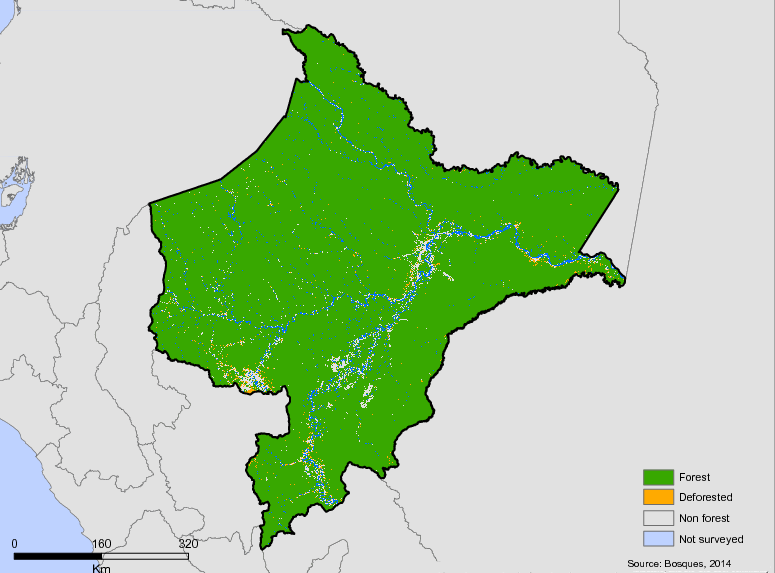
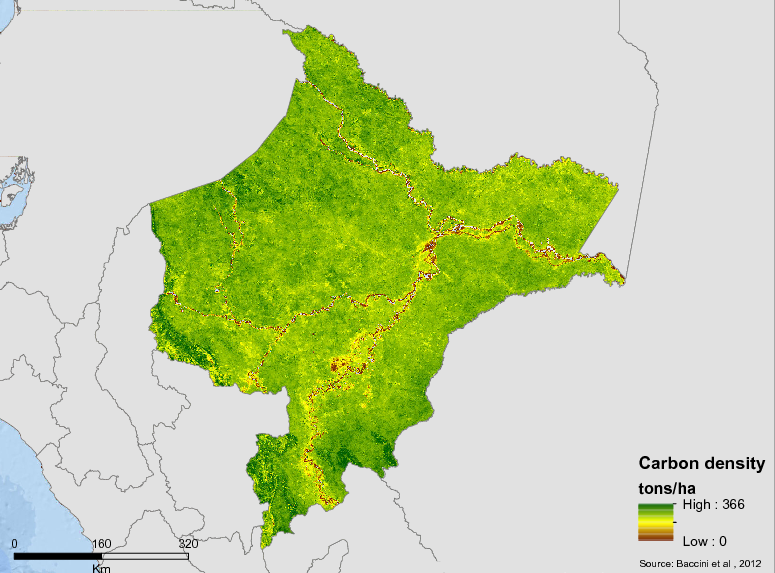
Loreto is the largest and most diverse region in Peru, with an area of 36,885,195.35 ha, which represents 28.7% of the national territory and 51% of the Peruvian Amazon.The region is home to extraordinary biological and cultural diversity, and it is also the department with the greatest forest cover in the country. Despite this, between 2001 and 2015 the region lost 341,845 hectares of forest according to national statistics. This places the region second, after the department of San Martin (with 382,058.00 hectares), for greatest forest loss in Peru during that time period. Data from the National Program for the Conservation of Forests and Climate Change Mitigation (PNBCC – MINAM), shows the trend of deforestation in Loreto is increasing, causing concern about the proper management of the region’s forests. To reverse this trend, the regional government has committed to develop strategies that are oriented towards the conservation of forests.
As part of these efforts, the Region has placed more than 13 million hectares of forests under some form of regional conservation, including Regional Conservation Areas, Conservation Concessions and Ecotourism,and conservation of headwaters of watersheds.
Through Regional Ordinance N ° 012-2015-GRL-CR, Loreto established the Regional Environmental Authority of Loreto (ARA LORETO) as a line agency dependent on the General Management of the Government Regional of Loreto. The ARA is the governing body responsible for defining policies, organizing, directing, controlling, monitoring, regulating and exercising functions in environmental matters, management and conservation of natural resources, promotion of environmental services and sustainable management of flora and fauna.The ARA operate with a territorial and ecosystem-centered approach.The ARA is led by a manager who oversee four Executive Directorates: the Executive Directorate of Environmental Management; the Executive Directorate of Conservation and Biological Diversity, the Executive Directorate of Forestry and Wildlife; and the Executive Directorate of Spatial Planning and Spatial Data.
The Executive Directorate of Conservation and Biological Diversity is the institution within Loreto’s ARA responsible for contributing to the sustainable development through the design and implementation of public policies, plans, programs, projects and strategies of management of the areas of regional conservation and the environmental services they provide, prioritizing their importance for the conservation and sustainable use of regional biological diversity.
Loreto has also prioritized the development and implementation of Regional Conservation Areas (ACRs for their acronym in Spanish) to address deforestation.The administration of the ACRs is framed by the guiding principles established in the Strategy for the Management of the Loreto ACRs, whichuses a co-management model to manage the biological, physical and social components of natural resources.It is through the principle ofCo-Management that synergies are established with the communities located in buffer zones of ACRs.Loreto recognizesthe important role of these communities in the conservation of the forests and natural resources of the ACRs and their communal territories. Currently in the Loreto Region there are four established Regional Conservation Areas, totaling an area of 2’199,885.09 hectares.
In the future, the challenge is to formulate and implement a holistic low-carbon development strategy that balances socioeconomic needs and forest conservation using a landscape approach.
Additional information can be found on the GCF Impact Platform.
Summary
Demographics
Urban vs. Rural Population
| Category | % | |
|---|---|---|
| Urban | 66.00 | |
| Rural | 34.00 |
Ethnic Groups
| Group | % | |
|---|---|---|
| Other | 54426 | |
| Kukama - kukamiria | 50000 | |
| Quechua | 38500 | |
| Chayahuita | 20000 | |
| Achuar | 10500 | |
| Awajun | 8000 |
Economy
GDP Breakdown
| Category | % | |
|---|---|---|
| Other sectors | 35.30 | |
| Public Administration and Defense | 25.80 | |
| Commerce | 19.50 | |
| Agriculture, Livestock, Hunting and Forestry | 10.20 | |
| Oil and Mining | 9.20 |
Forest Status
Major Vegetation Types
| Category | km² | |
|---|---|---|
| Humid low hills Forests | 202,113 | |
| Swamps | 51,025 | |
| Aguajales | 29,299 | |
| Humid Forest of Low Terraces | 21,988 | |
| Moist Forest of Mendric Plains | 17,561 | |
| Others | 13,234 | |
| Humid Mountain Forest | 10,908 | |
| Wet Forest of Terraces Stockings | 9,439 | |
| Humid High Hills Forests | 8,193 | |
| Humid Forest of High Terraces | 5,003 |
Forest Management
| Category | km² | |
|---|---|---|
| National Protected Areas | 68,343 | |
| Native titled communities | 64,846 | |
| Regional Conservation Areas | 21,999 | |
| Timber forest concessions | 21,910 | |
| Concessions for conservation | 2,697 | |
| Ecotourism concessions | 329 | |
| Other forest concessions | 76 | |
| Private Conservation Areas - ACP | 10 |
Drivers of Deforestation
There are no in-depth studies on the causes of deforestation in Loreto. The Strategic Environmental Study of the regional development plan notes that “deforestation originates due to various causes such as the exploitation of wood, the construction of roads and the conversion of forest areas to areas of agricultural activity ” (DAR, 2015). The Loreto Sostenible 2021 study (Dourojeanni, 2013), also notes that “the highest rates of deforestation are concentrated in the two areas served by roads and around Iquitos.” The first area is the one that corresponds to “area of high hills, which is crossed by the road that arrives to Yurimaguas from Tarapoto, the large plantations of oil palm established with use of machinery”. The second area is the one influenced by “the construction of the Iquitos-Nauta highway, in terrains with sandy-quartz soils, which has led to the extension of the agricultural occupation of this area up to 20 km on each side (Dourojeanni, 2013). The report also explains that “important extensions have also been deforested in recent years for agricultural purposes in the provinces of Alto Amazonas, Ramón Castilla and Maynas.” It is important to note also that Dourojeannu (2013) states that the main problem is not deforestation in Loreto, but rather degradation due to selective logging. Currently the extent of degradation in Loreto is difficult to measure.
Deforestation Rates
Notes
| a. | Due to different methodological approaches and base years, Forest Status data fields may differ slightly. Data sources for each field are listed below. |
Sources
| 1. | (INEI, 2016) link |
| 2. | (BCRP, 2016) link |
| 3. | (INEI, 2016) link |
| 4. | (BCRP, 2016) link |
| 5. | (PNUD, S/F) link |
| 6. | (PROMPERÚ, 2016) link |
| 7. | PNCB link |
| 8. | Geobosques 2016 |
| 9. | Peru FREL |
| 10. | Secretaría del Convenio sobre la Diversidad Biológica (https://www.cbd.int/doc/nbsap/sbsap/pe-sbsap-loreto-es.pdf) |
Overview of Forest Monitoring and Measurement Systems
Loreto is one of the most advanced regions in developing a system called Spatial Data Infrastructure, or IDER for its acronym in Spanish. This instrument seeks to “standardize the generation, transformation, exchange, dissemination and use of spatial information in territorial planning and informed decision-making”. In 2015, the technical office of the IDER Loreto presented the “Catalog of Geographic Objects of Forest Management”, which increases transparency of forest management through publicly available satellite images.
The primary source for data on deforestation and land use change in the region comes from the national GeoBosques platform. However, based on this platform, the Government of Loreto makes its own deforestation reports (early warnings) to carry out monitoring and control activities.
In addition, Loreto has elaborated a study titled “Estimation of Greenhouse Gas Emissions (GHG) of Loreto: Perspectives and Uses”, which estimates that 87 percent of the region’s greenhouse gas emissions come from land use change.
Reference Levels and Targets
Deforestation Rates
Sources
| 1. | Rio Branco Declaration based on national FREL |
| 2. | Peru FREL |
Laws, Policies & Strategies
Strategies and Policies
Regional Integrated Development Plan 2021 – The Regional Integrated Development Plan “Loreto al 2021″ is key tool for the present and future of Loreto to reach the goals of ‘Loreto 2021’, in a leading, orderly and competitive Amazon region, sustained in an economy with sustained green growth on the basis of a Territorial Ordinance, ecotourism, forestry, water resources and diversified production, conserving ecosystems, making sustainable use of their natural resources and with a border infrastructure of internal connectivity and clean energy.
Regional Climate Change Strategy (ERCC) – The regional government has completed the Climate Change Strategy in 2011 through Regional Ordinance No. 009-2011. Loreto is in the process of revising it regional climate change strategy through a technical group established in 2017.The technical group brings together civil society and regional and national government authorities.
Biological Diversity Strategy (ERDB) – In February 2017 (Regional Ordinance No. 001-2018-GRL-CR) a regional technical group was created to update the ERDB and prepare the Action Plan 2018-2022, this document is pending review by the Ministry of the Environment.
Agricultural, Aquaculture and Fishing Productive Economic Development Plan of the Loreto Region 2013 – 2018 – “Productive Consolidation Plan” (approved by Regional Ordinance 002-2013-GRL / CR).This plan seeks to promote the productive development of the region by prioritizing diversified value chains that consider the potential of the territory.
Laws and Regulations
Regional Ordinance N ° 001-2018-GRL-CR – Establishes a regional technical group to update the Regional Biodiversity Strategy and prepare the Action Plan 2018-2022.
Regional Ordinance 028/2017– Enacted in December 2017, this ordinance updates the Regional System of Environmental Management. This revises the Regional Environmental Commission, ratifies existing technical groups, and updates the Regional Environmental Action Plan and the 2004-2006 Regional Environmental Agenda.
Regional Ordinance 25/2017 – Establishes the “Technical Group of the Regional System of Environmental Management of Loreto” which is in charge of updating the proposal of the Regional System of Environmental Management of Loreto, through a regional participatory process.
Regional Ordinance 24/2017 – Established the “LORETO CLIMATE CHANGE TECHNICAL GROUP”; the same one that will be in charge of Updating the proposal of the Regional Climate Change Strategy and its Plan of Action, through a Regional Participatory Process.The group consists of 15 insitutions including regional and national government insitutions and civil society organizations.
Executive Resolution 12/2017 – Designates members of the Technical Team for the Forest Zoning process of the Loreto department, which was formalized Regional Ordinance 21/2016
Regional Ordinance 018/2017 – seeks to implement a Regional Energy Policy that focuses on renewable energies and the promotion of rural electrification.
Executive Resolution 12/2017– Appoints the members of the Technical Team for the Forest Zoning process of the department of Loreto, which was formalized as Regional Ordinance 21/2016
Regional Ordinance 5/2017 – Establishes the organizations participating in the Technical Committee for Forestry Zoning of the Loreto Department, including 16 national, municipal, and regional institutions.
Regional Ordinance 3/2017 – Promotes and recognizes indigenous environmental monitoring and vigilence in the Loreto Region, carried out by natural or legal persons belonging to peasant, native and/or indigenous or native communities.
Regional Ordinance N °025- 2016-CR / GRL– Establishes the Priority Sites for the Conservation of Biological Diversity with an extension of 10.1 million hectares and which comprises 27.5 percent of the regional territory.
Regional Ordinance 12/2015 – Establishes the Regional Environment Authority of Loreto (ARA LORETO), as a line organ, dependent on the General Management of the Regional Government of Loreto.
Regional Ordinance 005-2013-GRL / CR – Approves the official study called “Identification and Delimitation of Priority Basin Heads of the Department of Loreto” where 111 priority watersheds are identified and measures are issued for their adequate protection.
Regional Ordinance 11/2012 – Creates the regional technical group for adaptation and mitigation to climate change in Loreto; It will be in charge of preparing a proposal for a regional strategy for adaptation and mitigation of climate change and its action plan by 2021, through a regional participatory process.
Regional Ordinance 9/2011 – Approves the Loreto Regional Climate Chnage Strategy (ERCC)
Institutional Framework
Regional Management of Economic Development- Responsible for formulating, directing, coordinating, executing, supervising and evaluating policies to promote the productive sectors throughout the region.The Regional Directorate of Economic Development oversees the following units: Deputy Manager of Investment Promotion;Deputy Manager of Commercial Promotion;Regional Directorate of Agriculture;Regional Directorate of Energy and Mines;Regional Directorate of Production;Regional Directorate of Foreign Trade, Tourism and Handicrafts.The issue of land titling of native communities is under the responsibility of the Regional Directorate of Agriculture, who executes these activities through the Direction of Legal Physical Sanitation of the Agrarian Property (DISAFILPA)
Regional Directorate of Production-Loreto (DIREPRO)– The Regional Directorate of Production of Loreto is responsible for formulating, approving and supervising activities of extraction and cultivation of hydro and biological resources in inland waters, as well as productive activities, processing and manufacturing industries, both for external and internal consumption.The directorate is responsible for matters related to the promotion and development of cooperatives, micro and small businesses.
Regional Environmental Authority (ARA
Loreto)- In charge of defining policies, organizing, directing, controlling, regulating and exercising functions in environmental matters, management and conservation of natural resources, promotion of environmental services and sustainable management of flora and fauna, with a territorial and ecosystem approach, within the scope of the Department of Loreto.
Regional Development Fund (FONDELOR)-Responsible for administrating the resources from the oil canon to grant promotional credits to farmers, livestock and fisheries.It depends on the Regional General Management.
Zoning & Spatial Planning
The Regional Plan for Concerted Development Loreto – 2021 considers territorial zoning as part of Strategic Objective 5, to “Improve the infrastructure for regional competitiveness.” In it, the goal is to complete the ZEE in all of Loreto’s 8 provinces.The ZEE for Alto Amazonas is currently approved by Municipal Ordinance No. 018-2015-MPAA, which comprises 5 percent of the territory of Loreto.
According to a study of capacity for greater use dating from the year 2000 (cited in the Regional Government of Loreto, 2005),64.84 percent of the classification of vegetation in Loreto corresponds to areas of land suitable for forest production. 16.68 percent corresponds to bodies of water and the 12.28 percent correspond to land associations suitable for forest production and protection.
Engagement & Participation with Indigenous Peoples and Local Communities
One of the main desires of indigenous peoples is the titling of their ancestral lands. With the process of decentralization at the regional level, land titling is a function of the Regional Government. In Loreto, who exercises those powers is the Regional Agrarian Directorate through its Directorate of Legal Physical Sanitation of Agrarian Property (DISAFILPA).
By 2017, 6,484,632 million hectares have been titled in 707 indigenous communities, which represents 59% of the 1,200 communities settled in the department.
Loreto also carries out efforts to promote local conservation in regional conservation areas by formalizing rights to access natural resources and strengthening conservation, advancing co-management strategies, and strengthening the system of community monitoring and vigilance.
Partnerships and Ongoing Initiatives
Building the Resilience of Wetlands in the Province of Datem del Marañón, Peru
- Description
-
The swamps of Datem del Marañón hold a total carbon stock estimated at around 3.78 billion tonnes of carbon dioxide equivalent (CO2 eq.). The project will avoid deforestation of an estimated 4,861 hectares of palm swamp and terra firma forests over a 10-year period and enhance resilience and conservation of 343,000 ha of peatlands and forest. Climate change will also have profound impacts on the region, with more frequent droughts, flooding, and heatwaves, and changes in primary productivity, affecting people and ecosystems.
The project will facilitate better land-use planning and management of the region’s wetlands, while strengthening sustainable, commercial bio-businesses of non-timber forest products. It will entrust indigenous communities with the management of resources, improve their livelihoods, and empower women in the decision-making processes.
The funding will support government departments in developing the land-use plan, and provide support to community-based organizations for the participation of indigenous people. The largest share of funds will support bio-businesses, including for business plans, marketing and management, equipment and supplies, and the development of solar energy for operations. The nature-based products include salted fish, smoked meat, aguaje pulp (from palm trees), and “dragon’s blood,” a croton tree resin used as an antiinflammatory and anti-viral. - Partners
- Peruvian Trust Fund for National Parks and Protected Areas (Profonanpe)
- Funding Source
- Green Climate Fund, Govt of Korea
- Funding Amount
- $9.1 million
- Initiative Status
- Approved in 2015, estimated completion in 2022.
Forest Investment Programme- Integrated Forest Landscape Management Along the Main Route Between Tarapoto and Yurimaguas in the Regions of San Martin and Loreto
- Description
-
Anticipated project, to be finalized in 2018.
- Funding Source
- World Bank, IADB
- Funding Amount
- $12 million
- Initiative Status
- Awaiting final approval
Great Landscapes Program – Putumayo Amazonas
- Description
- The program “Grandes paisajes Putumayo Amazonas” promotes the creation of zones of use and conservation in the northeast area of Loreto. With an area of 3 million hectares and 44 native communities involved, the initiative looks to advance forest protection and stop illegal extraction and fishing. Through this model, a basis for shared management between the authorities and the local inhabitants is sought. The project seeks to create a normative framework and involves the authorities in the territorial planning proposals that affect the area.
- Partners
- Instituo de Bien Comun
- Initiative Type
- Local Communities
Implementing Strategies for transition at regional level towards a low-emission rural development in Indonesia, Peru, Mexico, Colombia and Kenya
- Description
-
Development of policies and monitoring instruments for rural development plan for the Amazon.
This project seeks reduce emissions of greenhouse gases (GHG) emissions associated with deforestation and promote sustainable use of natural resources in the field of six regional governments in the Peruvian Amazon as contribution to mitigation and adaptation to climate change, biodiversity conservation, improved livelihoods of the local population and the development of practices regional, national and international policies and market mechanisms for rural development under emissions.The project will be implemented in two scales. At the interregional scalepolicies and monitoring instruments will be developed for rural development plans for the Amazon under a competitive, inclusive and low emission approach. The second scale is local and focuses on the basin of the Pachitea to develop a platform for low-emission rural development and strengthen capacities of local authorities and indigenous organizations. Work on the Pachitea is led by Instituto del Bien Comun – IBC.
The project is expected achieve as first product the development of an Interregional Plan for promotion of a low emission development involving all participating regions. The project will also develop a platform for performance monitoring territorial performance as well as models of competitive and inclusive governance and incentives to reduce deforestation.
- Partners
- Regional Governments, Forest Trends, IBC
- Initiative Type
- Technical Assistance Partnership
- Initiative Status
- Under Implementation
Improvement of the environmental information service for the mapping of forest deforestation
- Description
-
The Project “Improvement of the environmental information service for the mapping of forest deforestation” is one of the four projects of the Forest Investment Program (FIP) approved for Peru. This Project seeks to strengthen the capacities of the Peruvian Government and key actors, such as indigenous peoples, to monitor deforestation. To this end, it proposes to articulate the georeferenced information systems, generate and distribute monitoring information, develop capacities to generate and distribute the information generated, the design of a community monitoring system as well as training and equipment for native communities. Specific activities for Loreto will be defined in 2019.
- Partners
- Ministry of the Environment, Ministry of Economy and Finance, Inter-American Development Bank
- Funding Amount
- S / 39,930,000 for the entire Peruvian Amazon. Total for Loreto not determined.
- Initiative Type
- Public investment project partially financed with resources from the CIF, operated by the IDB and deposited as a donation / loan to the Peruvian Government (60% donation / 40% loan in general for the entire program)
- Initiative Status
- At the start of execution (2018-2022)
Improvement of the income and employment of the families producing aguaje in Loreto (Aguaje Project)
- Description
-
This Project seeks to increase the income of rural families through the sustainable management of aguaje. The project considers training for the sustainable management of this palm tree, equipment and productive infrastructure, specialized training for commercialization and transformation, among other activities.
- Partners
- Ministry of Agriculture and Irrigation, National Forest and Wildlife Service
- Funding Amount
- S / 3,554,818.11 (S / 1,966,219.06 of FONDOEMPLEO)
- Initiative Type
- Project financed with public resources through FONDOEMPLEO and counterpart of SERFOR.
- Initiative Status
- In implementation (2017-2019 – 36 months)
Improvement of the promotion of sustainable use of aguaje in the forests of the middle basin of the Rio Pastaza, Loreto
- Description
-
The Project is implemented in the District of Pastaza, Province of Datem del Marañon, Department of Loreto. It seeks to improve the productive capacity of the populations settled in the middle basin of the Pastaza River. It also seeks to improve access to technical assistance services, monitoring and monitoring of these populations, in order to improve the productive chain of aguaje. It is estimated that the project will benefit 2,111 families.
- Partners
- Regional Government of Loreto, SERFOR
- Funding Amount
- S / 1,199,813.60
- Initiative Type
- Project financed with a conglomerate of SERFOR-CAF projects and the executing agency’s own resources
- Initiative Status
- In implementation
Improvement of the service of sustainable use of the biodiversity of the ecosystems of forest landscapes of the Tarapoto-Yurimaguas corridor in the departments of San Martín and Loreto (FIP San Martín and Loreto)
- Description
-
The San Martín Loreto FIP is a project financed by the Forest Investment Program (FIP) and seeks to strengthen the institutional capacity for the conservation of the forest landscape, contribute to the proper allocation of land use rights, generate management tools for conservation of forests, promote the sustainable use of forests and their ecosystem services, strengthen technical, organizational, business and commercial capacities for sustainable businesses; besides promoting sustainable businesses for the conservation of forests. Specific activities for Loreto will be defined in 2019.
- Partners
- Ministry of the Environment, Ministry of Economy and Finance, Inter-American Development Bank
- Funding Amount
- S / 40,260.00. Total for Loreto not determined.
- Initiative Type
- CIF Grant operated by the IDB, as a donation / loan Govt. Peruvian (60% donation / 40% loan in general for the entire program)
- Initiative Status
- At the start of execution (period 2018-2022)
Joint Declaration of Intent between the Governments of Peru, Norway and Germany (DCI) "Cooperation for the reduction of emissions of greenhouse gases from deforestation and forest degradation (REDD +) and to promote sustainable development in Peru"
- Description
-
The Joint Declaration of Intent (DCI) is a voluntary cooperation agreement signed by the Governments of Peru, Norway and Germany to achieve the reduction of greenhouse gas emissions produced by deforestation and forest degradation in Peru. It was signed in September 2014 with a validity until 2020 and considers actions for the conservation of forests in the Peruvian Amazon.
The JIU is based on a scheme of financial incentives on the progress and / or fulfillment of deliverables or goals divided into three phases: preparatory phase, transformation phase and payment by results phase. The phases of the JIU are directly related to the strategic actions of the National Strategy on Forests and Climate Change (ENBCC) and different planning instruments for development in Peru, such as: a) the Bicentennial Plan: Peru by 2021, b) The National Environmental Action Plan (PLANAA), c) the Agreed Regional Development Plans of the Amazonian regions in Peru, d) the National Strategy on Climate Change, e) National Strategy on Biological Diversity and its Plan of Action, f ) the National Forestry and Wildlife Policy, among other instruments.
The Phase II Implementation Plan defines in more detail what activities will be carried out in the Amazon Region. This document can be hired at: http://www.minam.gob.pe/cambioclimatico/wp-content/uploads/sites/127/2018/06/Plan-de-Implementación-Fase-II-DCI.pdf
- Partners
- Government of Peru, Government of the Kingdom of Norway Government of the Federal Republic of Germany
- Funding Amount
- Investment made so far at the national level USD6.5 M. Potential for cooperation: Up to USD240 million subject to progress in the goals of each phase and payment for results.
- Initiative Type
- Trilateral agreement between governments at the national level.
- Initiative Status
- In execution (Phase I and II)
National Program of Agrarian Innovation (PNIA)
- Description
-
The PNIA is a national incentive program of the Ministry of Agriculture and Irrigation (MINAGRI) that seeks to contribute to the establishment and consolidation of a modern national system of science, technology and innovation for the development of the Peruvian agrarian sector, decentralized, plural, oriented by the demand, in association with the private sector; with the purpose of increasing profitability and improving the competitiveness of the sector, through the generation and adoption of sustainable and environmentally safe technologies. This Program is conducted by MINAGRI and allows the implementation of projects oriented to innovation and technology development, which are financed by competitions. In Ucayali, 6 projects have been financed: 4 for extension services, 1 for applied research and 1 for strategic research. In San Martin, at least 23 projects have been financed: 4 for adaptive research, 1 for competency-based training, 1 for seed companies, 3 for strategic research and 14 for extension. In Huánuco, 8 projects have been financed: 5 on extension services and 3 on seed companies. In Amazonas, 26 projects have been financed: 6 for strategic research, 3 for adaptive research, 11 for extension services, 11 for competency-based training, 2 seed companies, 1 for applied research and 1 for technology transfer. In Piura, 43 projects have been financed: 3 for strategic research, 6 for adaptive research, 30 for extension services, 1 for skills training, 1 for seed companies, and 2 for technology transfer. In Loreto, 6 projects have been financed: 1 for basic research, 3 for applied research and 2 for technology transfer.
- Partners
- Ministry of Agriculture and Irrigation, National Institute of Agrarian Innovation
- Funding Amount
- Not determined for individual jurisdictions
- Initiative Type
- Incentive program for agrarian innovation at the national level
- Initiative Status
- Under implementation
National UN-REDD Peru Program
- Description
-
The UN-REDD National Program seeks to strengthen the strategic framework necessary for the implementation of REDD + and the ENBCC. Thus, it is expected to improve regional governance for the implementation of the ENBCC, NDC and REDD +, provide national or regional public institutions with instruments that facilitate the implementation of ENBCC, REDD + and NDC, develop public and private investment projects for the implementation of the policy, programs and measures prioritized in the framework of the ENBCC, to elaborate a proposal of reference level of forest emissions that integrate emissions data due to forest degradation, in addition to achieving that the indigenous approach is integrated in the module of forest cover and other SNIFFS modules in Peru, as appropriate. Specific activities for Ucayali will be defined in 2019.
- Partners
- Ministry of the Environment, UNDP, UNEP, FAO
- Funding Amount
- USD 4,065,779
- Initiative Type
- Project implemented through the national implementation modality (component under UNDP) and direct implementation (UNEP and FAO components)
- Initiative Status
- At the start of execution. Period December 2017-May 2020
Phase 3 of the Forests, Farms and Finance Initiative
- Description
-
Phase 3 of the Forests, Farms and Finance Initiative “Building bridges between local policies, REDD + and initiatives for sustainable supply chains” will support the construction of jurisdictional low emissions rural development plans.
In Peru, the 3FI initiative is led by the Earth Innovation Institute and the Amazon Regional Council (CIAM, in Spanish) and is developing incentives for low-emission rural development under a production and protection approach. The activities of 3FI in the Peruvian Amazon are led by the regional governments and are open to the participation of any public or private institution that wishes to contribute. 3FI considers with special attention the participation of indigenous peoples and women in the activities to be carried out. The initiative is based on empowering the progress of each region to make the necessary incentives proposals by building tailored instruments for each jurisdiction. Output from the project include: (a) developing regional plans or roadmaps to promote a transition to low-emission rural development; (b) promoting a transparent dialogue process at the regional level which includes the perspectives of indigenous peoples and women; and (c) developing a business plan to attract private investment and promote low-emission rural development in the Peruvian Amazon.
- Partners
- Earth Innovation Institute, CIAM
- Initiative Type
- Technical Assistance Partnership
- Initiative Status
- Under Implementation
Phase II of the Support to the Implementation of the National Strategy for the Reduction of Emissions for Avoided Deforestation and Forest Degradation in Peru "(RPP-2)
- Description
-
The RRP-2 Project 1.1. seeks to create the necessary conditions for the preparation and implementation stage of REDD + in Peru. This Project will consider strengthening spaces for citizen participation, such as the REDD + Indigenous Tables, the design of a grievance mechanism, implementing the PPIA, strengthening regional governments to implement the NDC and the ENBCC, and conducting studies for the effectiveness of strategies and land use planning instruments, contribute to the implementation of the national REDD registry, design benefit sharing mechanisms, improve the forest monitoring platform, update the forest reference level, design early response protocols to the monitoring reports of forests and implement a pilot of the Safeguards Information System. Specific activities for Amazonas will be defined in 2019.
- Partners
- Ministry of the Environment, FCPF, Ministry of Economy and Finance, Inter-American Development Bank
- Funding Amount
- USD 5,000,000.00 for all of Peru. Total for Amazonas not determined.
- Initiative Type
- Project that enters as a donation from the FCPF to the Peruvian Government through the IDB. Executed by MINAM (PNCB Executing Unit)
- Initiative Status
- At the start of execution
Preparing the way for the implementation of the Transformation Phase of the Joint Statement of Intent signed by the Governments of the Republic of Peru, the Kingdom of Norway and the Federal Republic of Germany
- Description
-
This project is considered as the first disbursement by the Norwegian Government to the Peruvian Government associated with the DCI. It considers four components or results: 1) the Government of Peru has planned the implementation of Phase II of the JIU and has begun its execution efficiently, 2) the zoning and forest management in the San Martin and Ucayali regions has increased, 3 ) value of the increased forest in order to be more competitive against the activities that cause deforestation and forest degradation, and 4) control of illegal activities that cause deforestation and forest degradation has increased. Activities in Loreto included titling of native communities, participation of the Regional Government of Loreto in the design of the Implementation Plan for Phase II of the JIU, the affiliation of new communities to the direct transfers conditioned by the National Program for the Conservation of Forests for Mitigation of Climate Change, among other activities.
- Partners
- Ministry of the Environment, UNDP
- Funding Amount
- USD 6,135,722. Total executed in Loreto not specified.
- Initiative Type
- Project executed through UNDP under the modality of national implementation
- Initiative Status
- In execution Period: June 2016-August 2018
Program for Sustainable, Inclusive and Competitive Forestry Development – SERFOR – CAF
- Description
-
The project supports Loreto in strengthening its forest management and surveillance capacity, including providing equipment for its headquarters and control posts. In addition, the project has specific activities with regional governments such as the management of protected natural areas, the forest cadastre, progress with the national forestry inventory, implementation of spatial data infrastructures, implementation of the anti-corruption plan for the forestry sector, improvements in control and forest monitoring, promotion of forest value chains, among other lines of work. The project also has a competitive fund for the presentation of public investment projects at the regional level.
- Partners
- National Forest and Wildlife Service, CAF, Regional Governments
- Funding Source
- CAF, SERFOR, Regional Governments
- Funding Amount
- 76,000,000
- Initiative Type
- Forest Monitoring and Land Titling
- Initiative Status
- In implementation
Project "Dedicated Granting Mechanism"
- Description
-
This project aims to support the communities of Loreto (and other regions of Peru) for the legal recognition of the territories and promote the development of indigenous communities respecting their life plans. According to the World Bank, expected results include i) recognition of 310 communities in the National Registry of Indigenous Communities; ii) demarcation of land, property titles and registration before SUNARP, and iii) implementation of 50 sub-projects of food security and 20 of income generation and 5 of sustainable wood production.
- Partners
- World Bank, WWF
- Funding Source
- World Bank
- Funding Amount
- 5,500,000
- Initiative Type
- Land Titling, Alternative Livelihoods
- Initiative Status
- In implementation
Project of Cadastre, Titling and Registration of Rural Lands in Peru – PTRT3
- Description
-
The PTRT3 financed by the World Bank and the Peruvian Government, has established ambitious targets for land titling.
According to the Inter-ethnic Association for the Development of the Peruvian Jungle – AIDESEP – several indigenous organizations have expressed their concern that the project could destabilize the territorial demands of the native communities, with a particular focus on Loreto where there is a significant number of native communities pending certification.In May 2017, the MINAGRI and Regional Government of Loreto signed an agreement to achieve greater commitments of the PTRT3 for the titling of indigenous lands. A Ministerial Resolution was also passed that simplifies soil evaluation to facilitate titling in native communities.Within the framework of these agreements, it is expected that in Loreto 200 native communities can be titled, and thus fulfilling half of the titling goals for native communities at the national level of the PTRT3.
- Partners
- GORE Loreto, Ministry of Agriculture, IDB
- Funding Source
- World Bank, Government of Peri
- Funding Amount
- US $ 80M
- Initiative Type
- Land Titling
- Initiative Status
- In implementation
Recovery and conservation of degraded ecosystems in communities of the lower basin of the Marañón River.
- Description
-
The Project is implemented in the District of Nauta, Province of Loreto, Department of Loreto. It seeks to develop the technical capacities for reforestation under agroforestry systems, strengthen the capacities of the producers in relation to the management and conservation of forests, organizational and financial management. It benefits 125 producers and will recover 32 hectares.
- Partners
- Regional Government of Loreto, SERFOR
- Funding Amount
- S / 1,199,813.60
- Initiative Type
- Project financed with a conglomerate of SERFOR-CAF projects and the executing agency’s own resources
- Initiative Status
- In implementation
Saweto Dedicated Grant Mechanism – Peru
- Description
-
Support Indigenous Peoples in the Peruvian Amazon in their efforts to establish the enabling conditions for sustainable forest management practices. Project Components:
Component 1 – Native Land Titling
Component 2 – Indigenous Forestry Management
Component 3 – Project Management, Monitoring and Evaluation
- Partners
- AIDESEP, CONAP, WWF
- Funding Amount
- US$5.5 million
- Initiative Type
- Iniciativa de Pueblas Indigenas
- Initiative Status
- Under implementation
Support for the implementation of the Joint Declaration of Intent on REDD + between Peru, Norway and Germany (WWF-DCI)
- Description
-
The WWF-DCI Project was executed during the 2015-2016 period and sought to contribute to the early implementation of the DCI. The Project considered five components or expected results: a) result 1. the Government of Peru, civil society and indigenous peoples increase their commitment to the implementation of Phase 2 of the JIU, 2) result 2. agrarian policies and instruments of regional development are improved and incorporate the approach of low carbon agriculture and production, protection and inclusion in San Martin and Ucayali, 3) result 3. Deforestation in two regions of the Peruvian Amazon (San Martin and Ucayali is monitored, 4) result 4. land tenure of improved native communities, and 5) result 5. improvement of forest protection in territorial reserves. Activities for the Amazon Region included the participation of the Regional Government of Amazonas in the design of the Implementation Plan for Phase II of the JIU.
- Partners
- Ministry of the Environment, Regional Government of Loreto, WWF, AIDESEP, CONAP, Forest Trends, Earth Innovation Institute, Alternate Development Mechanisms
- Funding Amount
- NOK 47,500,000. Total executed in Amazonas not specified.
- Initiative Type
- Project executed through WWF under the leadership of MINAM, MINCU, GORELO, WWF, Forest Trends, Earth Innovation Institute, Alternate Development Mechanisms
- Initiative Status
- Completed Period: 2015-2016
USAID / USF Program for Forest Supervision and Resource Strengthening – Forest
- Description
-
This cooperation program seeks to strengthen forestry authorities (national and regional) through specialized assistance for the development of forest standards, improve transparency, availability and use of forest information, develop a training program for authorities, regents and communities natives, contribute to the strategic planning of SERFOR, training on the management of forest fires, classification of forest products and support to the EIA of SENACE. Specific activities for Loreto will be defined in 2019.
- Partners
- USFS, SERFOR, Ministry of Agriculture and Irrigation, Ministry of the Environment
- Funding Amount
- To be defined by 2019
- Initiative Type
- USFS cooperation program financed with USAID / USFS resources to the Peruvian Government administered by PROFONANPE
- Initiative Status
- In implementation