Indonesia
Laws
Indonesia’s management of forest resources is based on the Forestry Law No. 41/1999 that regulates the utilization, protection, and conservation of the forest resources. The law highlights the sustainable management of the forest ecosystem and functions for the welfare of the people of Indonesia.
Law number 26/2014 – On trasnboundary cooperation to combat haze pollution
Law Number 18/2013 – on the prevention and eradication of forest destruction
Law No. 26/2012 – Spatial Plan. Indicative Moratorium Map – Decree of the Minister of Forestry Indonesia Number: SK. 2771/Menhut-VII/IPSDH/2012.
Government Regulation No. 28 of 2011 on the Management of Natural Reserve Area and Nature Conservation
Government Regulation No. 24/2010 – Forest Area Utilization
Law No. 32/2009 – Protection and Management of the Environment
Government Regulation No. 26/2008 – National Spatial Plan
Law No. 5/1990 – Conservation of Natural Resources and Ecosystems
Policies and Plans
Indonesia launched the REDD+ National Strategy in 2012 as the main reference for REDD+ development direction. The focus of the REDD+ national strategies cover: institutional formation and process; legal frameworks; strategic programs; paradigm shift and work culture; and, stakeholders involvement. In 2015, National FREL was submitted to the UNFCCC. Recently the ministry launched the national determined contribution in November 2016. The country is now preparing the third national communication (TNC) to be submitted to the UNFCCC as part of its commitment in contributing to the world’s climate change issues solving. Indonesi’as INDC submitted to the UNFCC pledges 26% unconditional and 41% conditional reduction. There are no targets for mitigation from forests.
Institutions
Indonesia had a REDD+ Agency that was formed in 2013 as the results to fill the needs for a firmed and focused agency in the formulation of REDD+ related policies and its preparation for implementation. The new government that was elected in October 2014 merged the agency into one ministry along with ministry environment, ministry of forestry and national council on climate change. The ministry, named Ministry of Environment and Forestry has one dedicated directorate general on climate change that house the REDD+ under the mitigation directorate.
The Government of Indonesia has the Ministry of Agriculture that manages and regulates the non-forest land for agriculture purpose and food security, including large scale plantations.
Indonesia has Geospatial Information Agency (Badan Informasi Spatial or BIG) that manages the information on spatial use and support its planning, and the recent one is leading on the formulation of ‘one map’ for all land use related activities.
In the recent years, the Government formed the Peat Restoration Agency as the answer and one of the solutions to the fires issue on the peatland that caused severe haze and hence GHG emissions.
Demographics
Urban vs. Rural Population
| Category | % |
|---|
Economy
GCF Member States / Provinces

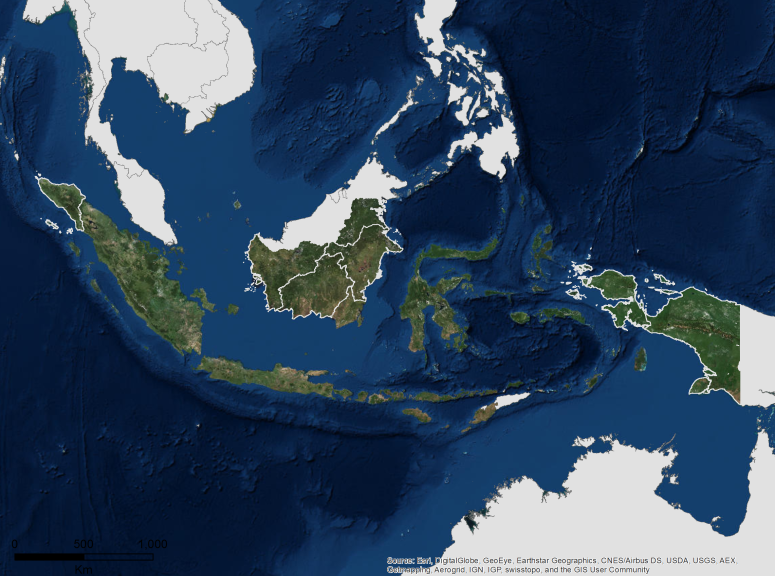
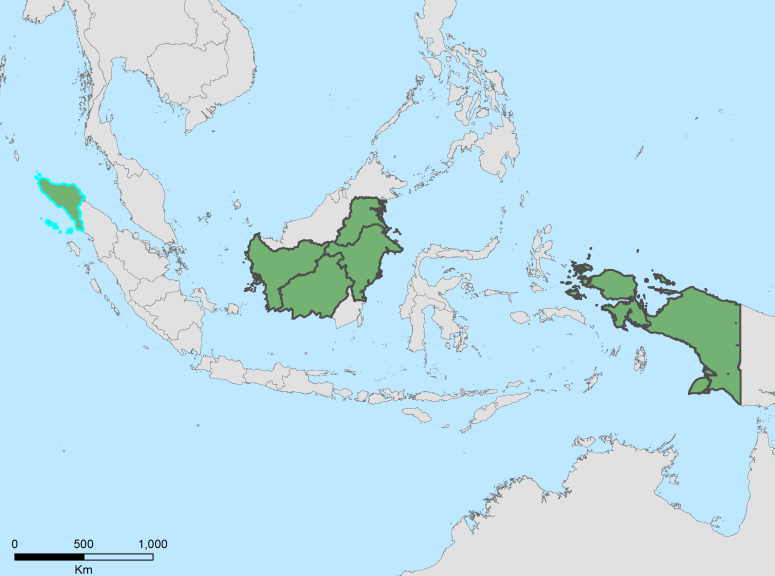
Aceh, Indonesia

Central Kalimantan, Indonesia

East Kalimantan, Indonesia
North Kalimantan, Indonesia

Papua, Indonesia
West Kalimantan, Indonesia
